Super funds and institutions drive Australia’s $2b large format retail boom
Australia’s biggest property investors are increasingly turning their attention to large format retail (LFR), with superannuation funds and institutional buyers entering a market once dominated by private investors.
The shift follows a record year for the sector, with more than $2 billion worth of large format retail properties changing hands in 2025 and investment momentum continuing into 2026.
Among the latest entrants is investment manager MA Financial, which recently launched a dedicated large format retail fund targeting a portfolio worth more than $500 million.
But as more investors compete for properties housing retailers such as Bunnings, Harvey Norman and JB Hi-Fi, opportunities to buy are becoming increasingly scarce.
Big investors enter the market
JLL head of retail investments Australia and New Zealand Sam Hatcher says investor demand for large format retail is not only strong, but coming from a much broader pool of buyers.
“Demand is as strong, and more importantly as broad, as we’ve seen it,” Hatcher says.
“A few years ago, LFR was largely a private investor market with a couple of specialist REITs active. Now we’re seeing super funds, listed groups and wholesale funds at the table alongside the private buyers.”

The growing institutional interest is already translating into major investment commitments.
MA Financial’s new fund will initially be backed by the $49 million ECQ XL large format retail centre in Western Sydney, acquired from Vicinity Centres.
The 11,000-square-metre centre is home to major retailers including Officeworks, Anaconda and 4WD Supacentre, with MA Financial also undertaking due diligence on two further properties for the fund.
MA Financial co-head of core real estate Chris Lock says constrained supply and low vacancies are creating attractive opportunities for rental income growth, while active management of properties could generate additional value.
The expanding investor pool could also mean more competition for a relatively small number of available properties.
Hatcher notes that major wholesale investment funds are still holding considerably less retail property than their long-term averages, leaving room for further investment as capital flows back into those funds.
“With money flowing back into those funds, LFR is likely going to be one of the first places they’re looking,” Hatcher says.
Too expensive to build
Part of the appeal of established centres lies in how difficult they have become to replace.
Despite strong demand from retailers, the cost of developing new large format retail space has risen so sharply that many projects are no longer financially viable.
Hatcher estimates a newly developed centre would need rents roughly twice current market levels to justify construction costs.
“The demand is there, but rents haven’t risen anywhere near as fast as the cost of building,” he says.
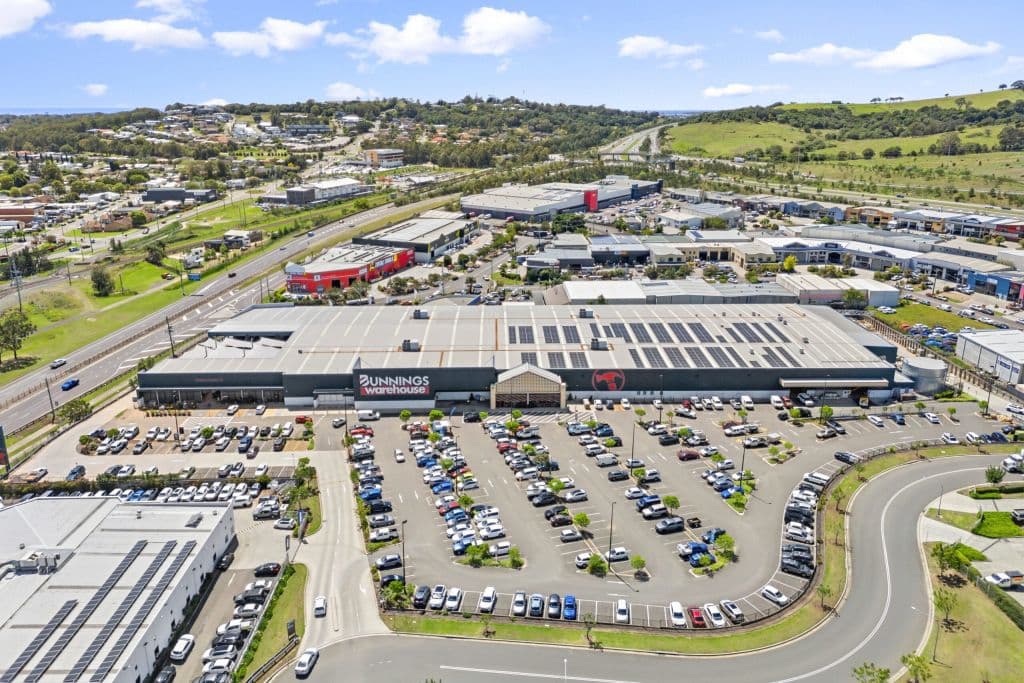
Construction costs have risen at almost four times their pre-pandemic pace, leaving developers struggling to make new projects financially viable.
While some developments are proceeding, new supply remains well below pre-pandemic levels and, according to Hatcher, is insufficient to accommodate demand from a growing population.
For investors, the shortage makes existing centres more appealing. With few new competitors entering the market, established landlords are better positioned to retain tenants and increase rents.
According to Hatcher, a handful of landlords control more than half of Australia’s investable large format retail stock, meaning quality assets rarely become available for purchase.
Low vacancies, rising returns
The supply squeeze is already being reflected in rental performance.
National large format retail vacancy is around 2.3 per cent, according to JLL, with rents increasing by more than 5 per cent over the past year.
Conditions are even tighter in Sydney and Melbourne, where vacancy rates are below 1.5 per cent and annual rental growth is running between 7 and 9 per cent.
With limited alternative premises available, retailers looking to renew their leases have less bargaining power, giving landlords greater scope to negotiate higher rents.
For investors, that means the potential for growing rental income, rather than relying solely on increases in property values.
Hatcher believes there is room for rents to rise further, noting that large format retail premises remain considerably cheaper to lease than space in neighbourhood shopping centres.
That relative affordability could let landlords raise rents without putting the same financial pressure on tenants as in more expensive retail locations.
Despite the sector’s strong leasing conditions, Australia’s interest rate outlook presents a challenge for investors.
The Reserve Bank has raised the cash rate four times this year to 4.60 per cent, increasing borrowing costs for debt-reliant buyers.
Higher financing costs can reduce the prices investors are willing to pay, even as a property’s rental income grows.
Hatcher expects the shortage of new supply to continue supporting demand for large format retail assets, but believes higher interest rates could limit further increases in property values.
“That will weigh on pricing in the short term, particularly for buyers relying on debt,” he says.
“We’d expect yields to hold rather than tighten further over the next year or so, with investors leaning more on income growth.”
In other words, the next phase of investment returns may depend less on buying properties that subsequently rise in value, and more on the additional rent those properties can generate.