How placemaking and commercial property fight loneliness
Ending Loneliness Together’s 2026 State of the Nation report was released this week, coinciding with the annual Loneliness Awareness Week.
It revealed that more than half of Australians aged 12 to 95 are experiencing some form of social disconnection, either social isolation (the objective lack of connection), loneliness (the feeling bred from disconnection) or both.
In recent years, loneliness has become recognised as a public health issue, but increasingly, the commercial property sector is seeing it as a placemaking one.
The places where people live, work and gather play an integral role in fostering connection, and designers and developers alike are rethinking how commercial spaces can help bring people together.
The role of design and the built environment
The report pointed to a myriad of factors behind loneliness, but specifically highlighted the role of the built environment – particularly workplaces and urban planning – as a key preventative tool.
“Things in our environment, in our buildings and in the policies that govern the way we live, work and play help prevent the onset of loneliness,” says Dr Michelle Lim, Ending Loneliness Together’s scientific chair and chief executive.
Lim identifies community – that is, the neighbourhoods and places beyond family, friends and colleagues – as one of the most powerful yet untapped resources.
“Social disconnection is almost the default state. We need to be intentional with our community connections,” she says. “[Community spaces] promote diversity of where they connect, not just home or school or work.”
Design studio Hassell has long viewed connection as a fundamental design principle, believing buildings should go beyond pure function.
“Architecture, landscape and urban design … is about setting the stage for life rather than just designing functional places and spaces,” says Hassell principal Ben Rees.
Sophie Bond, fellow principal at Hassell, believes building and precinct design can help foster belonging or reinforce isolation.
“The built environment can’t solve everything, but it can absolutely make connection either easier or harder,” she says.
“[It’s about] creating shared amenity and value in places that people not only want to come to the first time, but want to return to, that they feel like they identify, they feel like they belong, and it’s memorable for them.”
From functional buildings to connected communities
That philosophy is increasingly informing mixed-use developments, as developers seek to create spaces that encourage communities to interact.
Rees says many mixed-use precincts are now embracing a “village” or “town square” model whereby residents and workers alike can enjoy a range of shared amenities that cultivate a sense of belonging.
Hassell’s recent Murdoch Square project – a mixed-use health precinct in Perth – brings together aged care, medical facilities, retail and offices.
“When you start to bring these different typologies together, people start to connect in ways that might surprise,” says Rees. “It’s really the old village model.”
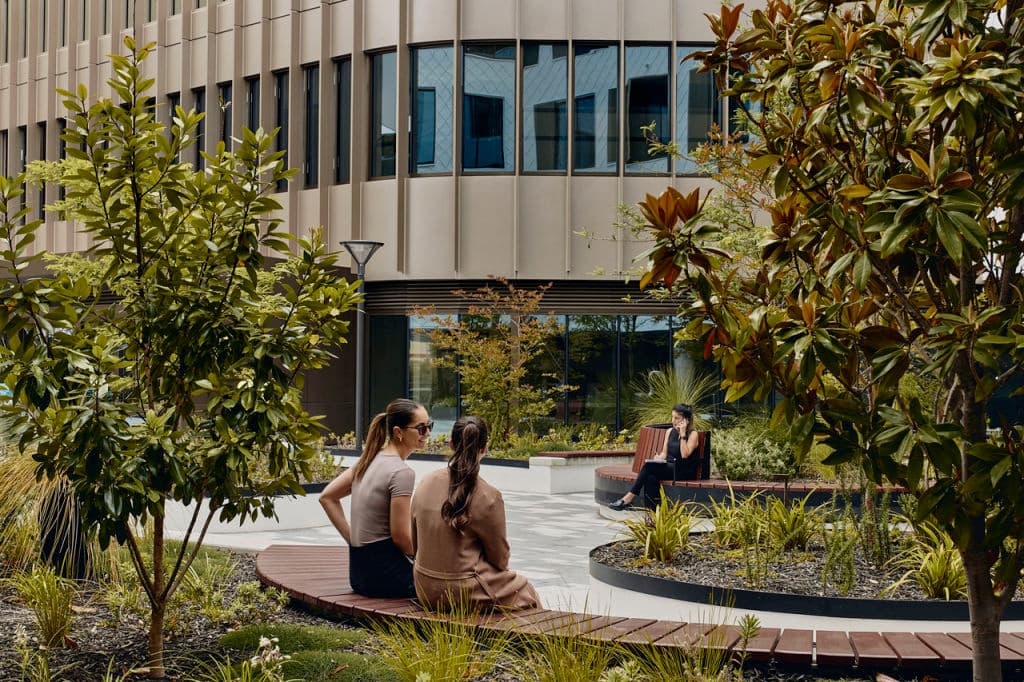
Alongside the amenities themselves, Rees highlights several design details, including shade, comfortable seating, walkability and green space, that play an important role.
“It’s got to be a comfortable space where people want to dwell,” he says.
Lim acknowledges the role of the built environment, but adds that the people within are equally fundamental.
“It’s not just the hardware. Even if you have all this wonderful infrastructure, if you don’t have people who are natural connectors, you’re missing a really important piece,” she says.
“There are people who are natural connectors in our workplaces and communities … the little things they do make such a big difference.”
Master-planning social spaces
Some developers are treating connection not as a nice-to-have but as a core part of master-planning.
Frasers Property is a long-term partner of Ending Loneliness Together and has embraced the need for social connection throughout its portfolio.
“At Frasers Property, we embed the social sustainability program at the master-plan level to ensure connections are created for people, so that community activities and events become integral to the people that live and work there,” says the executive general manager development, Emily Wood.
Many of the developer’s precincts combine residential, retail and workplaces, and offer shared public spaces and community programming.
“By blurring the lines between uses, such as integrating residential homes with community spaces and then neighbourhood retail, we can design places which make connections with neighbours in shared spaces part of people’s normal daily routines,” says Wood.
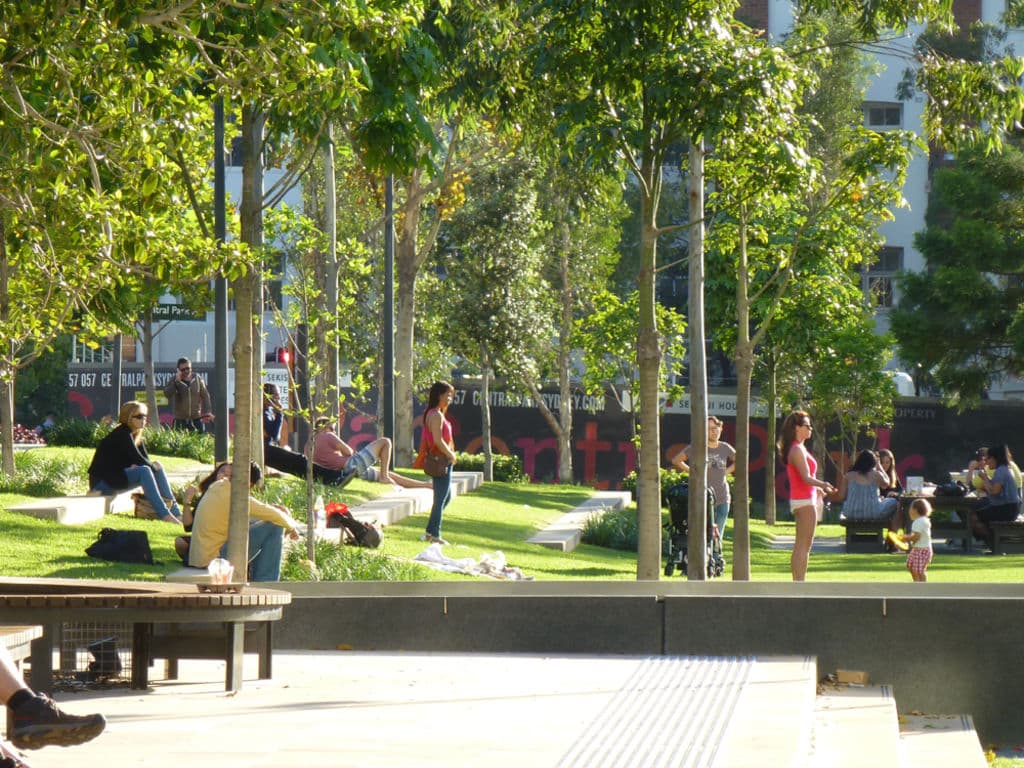
Green space is a particularly important feature, giving people informal opportunities to interact.
“At the community level, it means investing in community gardens, walking and cycling paths, green links, open spaces and other amenities which accommodate social activations like community barbecues, walking groups and other community-specific opportunities for connection,” says Wood.
Commercial value and ROI
One of the report’s key findings was that loneliness and social isolation were especially prevalent among casual and part-time workers (including those in hybrid arrangements), underscoring the essential role of the workplace.
Lim adds that those aged 45 to 54 – a major segment of Australia’s workforce – were the most socially disconnected age group.
“That is our workforce … probably the one we expect to be thriving,” she says. “They’re caring for children … caring for older people … they don’t have time to foster their own social connections.”
Offices are already working hard to attract staff, implementing everything from next-level end-of-trip facilities to premium amenities designed to entice workers in. Social connection may just prove to be another powerful drawcard.
“Commercial assets have become optional … they need to earn the commute,” says Bond. “People are returning to places they view as being more exciting … more beautiful … focused on shared value.”
Lim adds that this is where some office spaces fall short, with traditional open-plan design sometimes hindering connection.
“Just because you put more people together doesn’t mean they’ll get along,” she says. “Open spaces can actually increase email contact, and people talk less.”
The retail sector is also responding to the shift, with shopping centres becoming places for connection rather than pure commerce.
“Beyond being merely a place for transactions but instead a place to socialise, relax, dine and be entertained, the retail centres we have created have become the natural heart of the communities they serve,” says Wood.
“They are naturally adopted by locals as a place they belong to … and which become meaningful places for people to connect.”
Bond adds that the benefits of connection-focused design can even flow on to commercial performance.
“People vote with their feet. If they’re choosing to spend their time in your precinct, in your lobby, in your coffee shop, I think that’s a really intuitive measure that you’re doing something right,” she says.
“Creating opportunities for connection becomes a huge attractor … encouraging footfall and dwell time.”
While the places we build have enormous potential to foster connection, and there are clear commercial benefits, loneliness is a complex and systemic issue and one that can’t be solved by property alone. Lim argues that the solution requires coordination across sectors, including government, employers, communities and the property industry.
“Australia needs to have some sort of national strategy to work across sectors to really address this issue,” she says. “Build buildings for a bigger cause and be part of the solution.”