Olympics and online shopping fuel Brisbane industrial property boom
A surge in online buying, the 2032 Olympics and steady population growth have combined to make Brisbane’s industrial market the hottest in Australia.
Latest Colliers research shows the average vacancy length for Brisbane’s industrial properties was 2.2 quarters, approximately seven months, for the June quarter this year. It’s the lowest on the east coast and a drop from 2.4 quarters in the March quarter.
Colliers also recorded an uplift in rental growth, driving some industrial tenants to pounce on available properties sooner than they ordinarily would have.
“Brisbane has had the strongest rental growth in recent years and that’s creating a little bit of a sense of urgency where occupiers are trying to get in before rents grow too significantly,” says Jordan Pangallo, senior manager, research at Colliers.
“That rental growth is now catching up to the more established markets of Sydney and Melbourne. It’s really accelerated in the last two or so years and we’re seeing occupiers move to get the space they need before rental growth continues.”
Brisbane’s net face rental rates per square metre per annum reached $185 in the June quarter, up from $169 in the 2025 June quarter, Colliers data shows.
Online shopping boom fuels warehouse demand
Ecommerce is pushing demand for industrial space, with the latest Australia Post data showing Australians spent a total of $82.6 billion in 2025 – up 14 per cent on 2024. It reflects the increasing competition in the online shopping space where customers expect faster delivery times.
Australia’s appetite for digital spending is propelling a greater need for strategically located warehouse and distribution centres. Colliers research suggests the emerging markets of Brisbane, Perth and Adelaide stand to reap the benefits.
In 2025, Queensland recorded the highest online spending per capita nationally at $3116 per person, while Western Australia led annual online spending growth in 2025 at 18 per cent, followed by Queensland at 15 per cent and South Australia at 14 per cent.
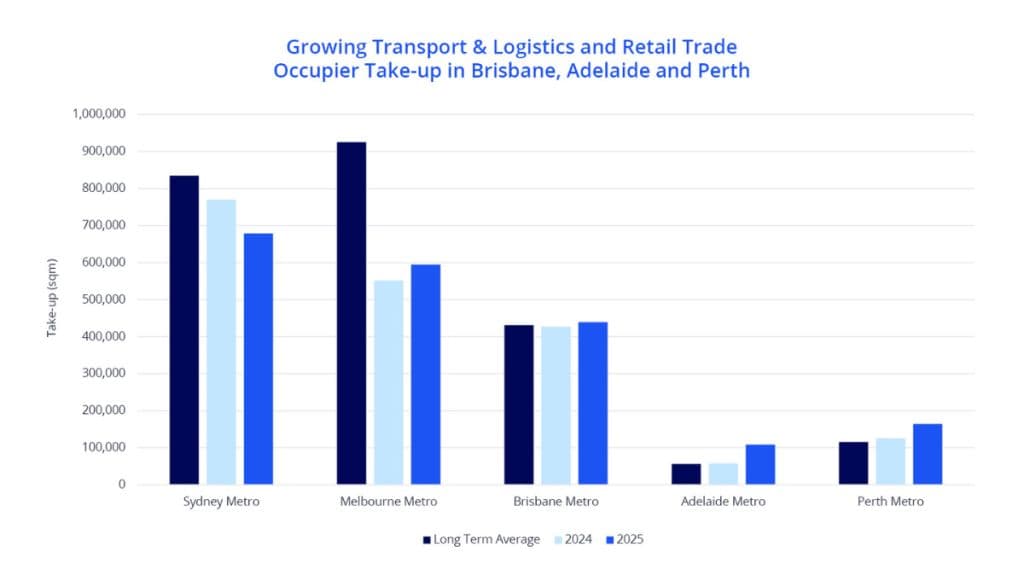
“In Queensland they have the highest household spend per capita for online spending than any other market and that’s already translating to our transport and logistics, 3PL and retail occupiers who have already seen a really significant demand jump from 2024 to 2025, and we’ll keep seeing that again in 2026,” Pangallo says.

Why Brisbane remains a standout industrial market
Industrial vacancy in Brisbane sits at 3.5 per cent, below Melbourne at 4 per cent and Sydney at 3.9 per cent, but above the tight conditions in Perth at 1.7 per cent and Adelaide at 2.7 per cent.
Within metro Brisbane, the outer north and Yatala are the tightest markets, both recording vacancy rates below 1 per cent.
In prime grade assets, Brisbane’s industrial net face rents range between $168 and $203 per square metre and $148 and $168 per square metre in secondary assets.
Occupiers are competing for less space with gross supply decreasing across Brisbane’s industrial market from 500,029 square metres in 2025 to 454,042 square metres in 2026.

The Olympics may be six years away, but the city’s industrial needs are escalating as preparations ramp up. Construction of stadiums, athlete villages and upgrades to transport and public facilities is set to drive up demand for fabrication yards, materials storage and equipment logistics. There’s also the surge in goods and services resulting from the hundreds of athletes, officials, media and spectators who will arrive en masse ahead of the opening ceremony in July, 2032.
Experts predict businesses will begin to set up new operations or scale existing facilities to meet demand three to five years out from the Games, according to Colliers’ Brisbane 2032 Olympic and Paralympic Games: Creating Solutions report.
Healthy population growth is another success story for Brisbane, with the latest Australian Bureau of Statistics data showing a 2.1 per cent bump between 2024 and 2025 – the second-largest increase behind Perth at 2.4 per cent. That represents more than 58,000 people who now call Brisbane home.