Australian Venue Co secures two landmark Sydney pubs for more than $90m
Australian Venue Co has exchanged contracts to acquire two of Sydney’s best-known inner-city pubs, The Clock Hotel in Surry Hills and The Bank Hotel in Newtown, alongside a private freehold property investor for over $90 million.
The Clock component represents the largest Australian transaction recorded for a food-and-beverage-focused pub, although the specific price was undisclosed, with minimal gaming and no accommodation.
JLL Hotels & Hospitality Group’s John Musca, Ben McDonald and Kate MacDonald conducted the international sales campaign on behalf of private investors after bringing the portfolio to market in May.
“It was an international sale process, public and highly competitive. We had bids from family offices, individual private hotel groups, and the larger corporate hotel groups,” says Musca.
Musca says the separation of property ownership and venue operations was becoming an increasingly important source of capital for the pub sector.
“The partnership between Australian Venue Co and property capital represents a growing investment model in the hospitality sector,” he said.
“It combines operational expertise with long-term real estate ownership, with the potential to maximise both trading performance and asset-value appreciation.”
The two hotels were originally offered alongside The Sackville Hotel in Rozelle as part of the same campaign. Merivale separately exchanged contracts to acquire The Sackville for more than $44 million, with completion subject to ACCC clearance.
The deal ends lengthy periods of ownership for both properties. The Clock had been held for 23 years and The Bank Hotel for 14 years, with both venues operated by Solotel.
Despite the significance of the transaction, Musca says patrons should expect continuity rather than an immediate overhaul of either venue.
“We expect it will be business as usual,” he says.
“There won’t be any discernible changes to the positioning or operation of the venues, other than the benefits that come from being part of one of the country’s largest hospitality groups. It is not something patrons are likely to notice.”
The appeal of these pubs isn’t solely in their hospitality offering, but also rests on the scarcity of the underlying property. Limited liquor licences, planning restrictions and a shortage of comparable sites create significant barriers to new competition.
Musca explains that the performance of established hotel businesses has strengthened the investment case for the sector during a period of wider economic uncertainty.
“Historically, growth in hotel trade has outperformed other forms of retail business.
“With the high barriers to entry, these businesses continue to become larger, and their cash flows more attractive, particularly in a world of economic and financial uncertainty.”
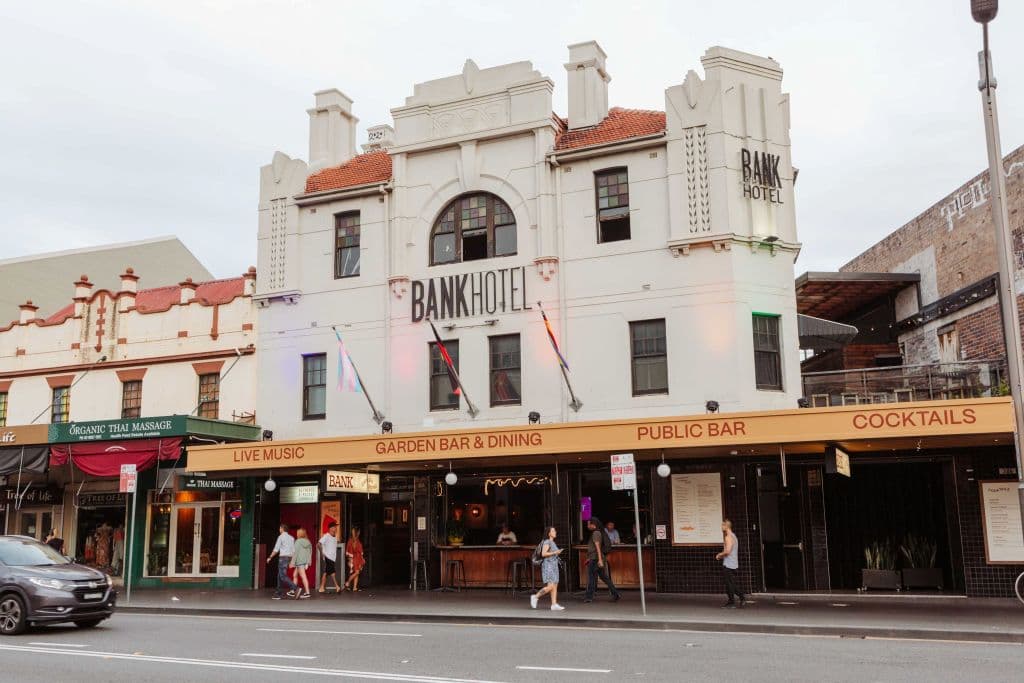
The two hotels occupy prominent corner sites but draw their trade from markedly different parts of Sydney’s hospitality economy.
Established in 1863, The Clock stands on Crown Street in the heart of Surry Hills. Its income comes from its bars, food operation and bottle shop, with gaming limited to 10 machines.
The venue is close to Central Station, the expanding Tech Central innovation district and the Moore Park sports and entertainment precinct, which includes Allianz Stadium and the Sydney Cricket Ground.
The Bank Hotel, established in 1880, sits on King Street opposite Newtown Station, through which more than 16,000 commuters pass each day.
It also holds a 24-hour liquor licence and operates within Newtown’s Special Entertainment Precinct. Other nearby sources of demand include the University of Sydney and Royal Prince Alfred Hospital, where a $940 million redevelopment is underway.
“Crown Street and King Street represent two fundamentally different but equally compelling hospitality environments – one defined by lifestyle dining and urban density, the other by entertainment culture and late-night trade,” says McDonald.
“What unites The Clock and The Bank Hotel is their ability to maintain relevance across generations of patrons, their position at the centre of high-traffic precincts and their track record of consistent trading performance regardless of broader economic conditions.”