Luxury brands flock to Perth's Murray Street as CBD retail vacancy rates fall
Luxury retailers are putting the posh into Perth as luxury retailers increasingly enter the upmarket Murray Street precinct. New research shows the entry of major brands such as Paspaley Pearls and Christian Dior is being well received by shoppers and making a positive impact on vacancy rates.
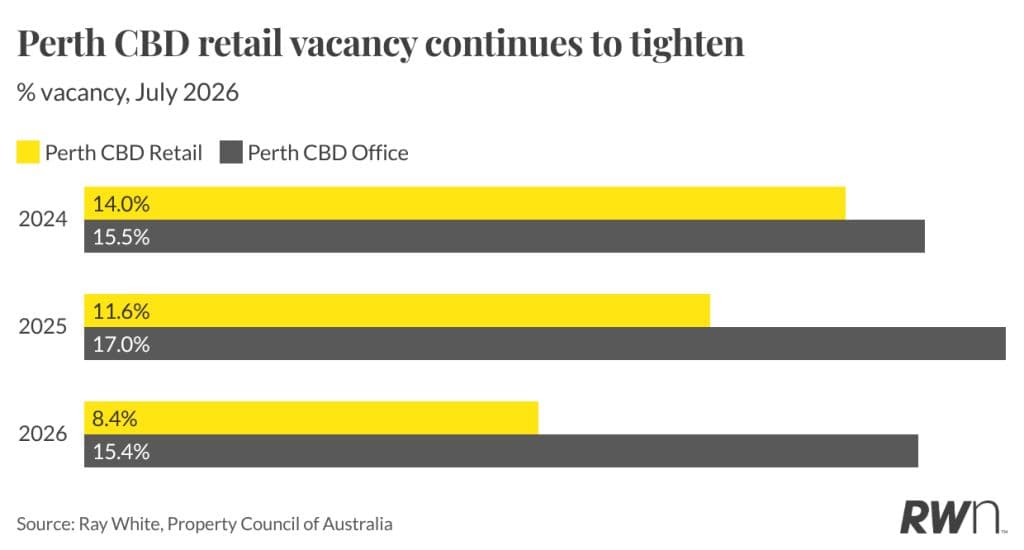
Latest figures from Ray White Group show Perth’s vacancy rates fell to 8.4 per cent in July – the sharpest vacancy improvement of Australia’s major capital cities.
It’s a big shift from the elevated vacancies of 11.6 per cent in 2025 and 14 per cent in 2024.
Tightening vacancy conditions reflect a growing appetite for luxury goods in the West Australian capital, says Vanessa Rader, Ray White’s head of research.
“The tenant mix confirms Perth’s growing position as a premium fashion and luxury destination,” she says.
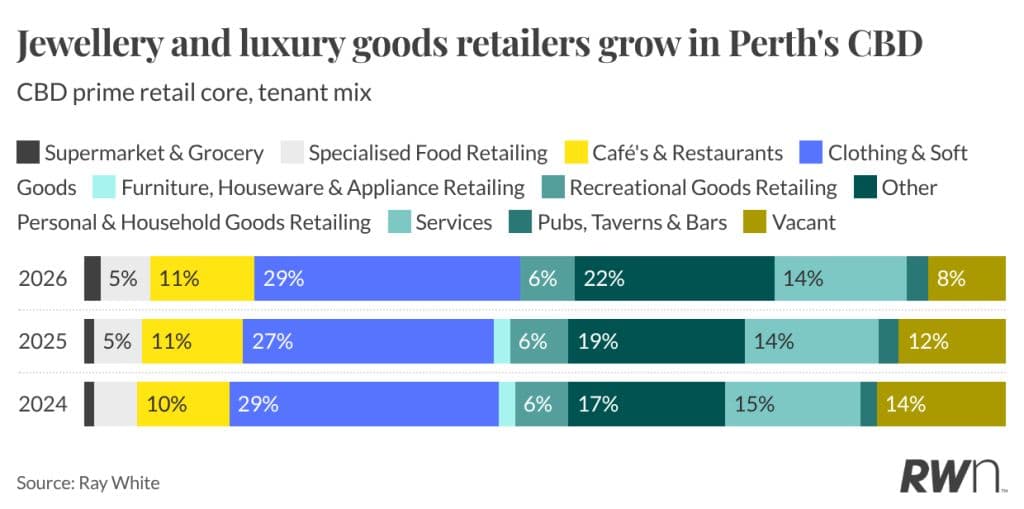
“Other personal and household goods retailing, largely jewellery and watches, has climbed sharply to 21.6 per cent from 17 per cent in 2024 [and is] now one of the largest categories of any capital in the survey.”
Murray Street cements its luxury credentials
The historic buildings on Murray Street make it a favourite city location for shoppers, and its appeal has increased as more luxury brands have opened their doors. Paspaley Pearls is converting an old heritage-listed substation into a showroom, and will join the likes of famed fashion brand Christian Dior, jewellery label Van Cleef & Arpels and Watches of Switzerland.
Ray White data shows clothing and soft goods represent the largest portion of retail tenants in Perth, making up 28.7 per cent of the total tenancy mix. Cafes and restaurants account for 11.4 per cent of city retail tenants, while furniture, houseware and appliance retailing has completely withdrawn from Perth’s CBD.
Drilling down to the vacancy rates on major city streets, it’s clear that big-name luxury retailers are performing most competitively. Murray Street has the tightest vacancy in Perth at 7.1 per cent, followed by Hay Street at 8.2 per cent, Forrest Place at 10 per cent and William Street at 11.5 per cent.
Vacancy rates fall as retailer demand strengthens
Strong retail conditions in Perth form part of Western Australia’s positive economic conditions, with office vacancies also improving, the data shows.
“This sits alongside one of the country’s strongest office market turnarounds, with vacancy improving to 15.4 per cent from 17 per cent in 2025, positioning Perth as one of the few capitals where retail and office fundamentals are moving in the same direction simultaneously,” Rader says.
Consumer spending data shows West Australians are buying more online, with Australia Post’s latest eCommerce Report showing households spent $9.1 billion – up by 18 per cent year-on-year.
According to Australian Bureau of Statistics household spending data, the state recorded the country’s third-strongest increase in June, with a rise of 1.3 per cent, just behind the ACT at 1.4 per cent and Tasmania at 1.6 per cent. The categories driving spending were alcoholic beverages and tobacco, which increased by 4.4 per cent, transport by 3.2 per cent and recreation and culture by 1.5 per cent.