Older Australians outspend younger shoppers, forcing retail rethink
Retail landlords are on notice: don’t forget older shoppers.
That’s the message from experts who say shopping centres risk alienating older demographics as they move away from traditional models and towards more tech-integrated, experiential retail.
Older consumers power retail growth
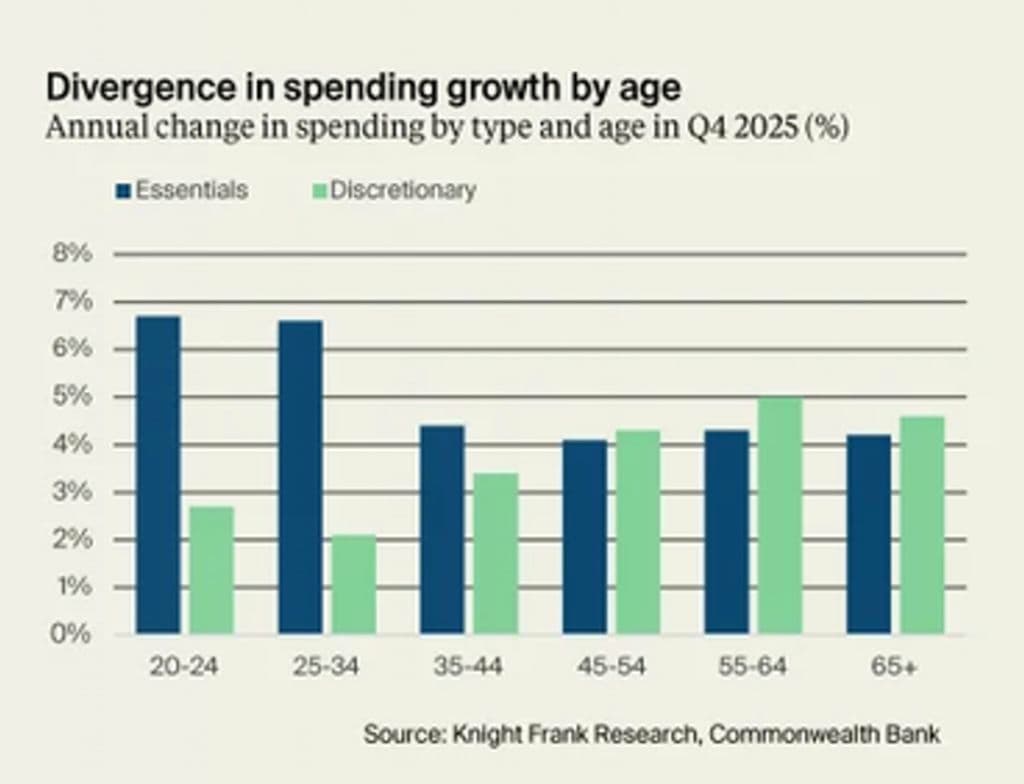
It comes as research shows that Baby Boomers and Gen Xers are propping up Australia’s retail economy by spending more on discretionary items, such as travel and dining, than on essentials. Australians aged 45 and older have far greater spending power than those under 45, who are buying more essentials such as groceries and transport.
“It really kicked off in earnest when interest rates started rising – that really had quite a big effect on pulling back the discretionary spending for younger cohorts,” explained Alistair Read, Knight Frank’s senior economist, research and consulting.
“The older generations typically don’t have mortgages, so high interest rates mean they make higher interest off those savings. Also, we’ve seen stock markets perform relatively well recently, and many older generations now hold shares.
“And we’ve also seen really strong house price appreciation. So when all of those factors come together, it boosts the spending potential of the older generations in a way that that doesn’t favour the younger generations and then that translates through to spending.”
Youth focus leaves retailers exposed
Retail research shows that shoppers aged 60 to 78 are increasing their e-commerce spending, accounting for $12.5 billion in 2024 and eclipsing Gen Z shoppers aged 18 to 26 at $10.6 billion, according to retail marketing agency Fox and Lee.
It’s a reminder for the retail industry to market to both ends of the age spectrum, said Madeline Kulmar, senior retail strategist at Retail Oasis.
“The data is a useful reality check for any retailer who’s gone all-in on youth marketing,” she said.
“Boomers are not just spending, they’re outspending younger cohorts in discretionary categories, and they have the disposable income and time to shop deliberately and loyally.
“Yes, Millennials will become the dominant population cohort within five years, but population size and discretionary spending power are two very different things. Retailers investing in younger customer relationships are playing a smart long game, but they can’t afford to take their eye off the cohort that’s actually spending right now.”
Landlords shift strategy on shopper mix
Retail investors and landlords are combining wellness facilities into shopping hubs to appeal to a broader age group. Kulmar points to successful examples, including Virgin Active’s Wellness Club at Westfield Bondi Junction, which offers fitness, recovery, nutrition, and social experiences, and the 5300 square metres dedicated to health and wellbeing delivered as part of Chadstone’s $685 million redevelopment.
“Looking ahead, the pressure will be on landlords to support tenants in creating physical environments that justify the trip for both ends of the age spectrum: experience and discovery for younger shoppers, comfort, service, and ease of access for older ones,” Kulmar said.

Knight Frank’s latest Australian Retail Review found household spending across all age groups increased by 4.6 per cent in the year to February 2026. The data showed consumer spending rose across recreation and culture (8.8 per cent), food (6.6 per cent) and hotels, cafes and restaurants (5.7 per cent).
Discretionary spending for the 65-plus age group was likely to be travel expenses, but for younger age groups, it was restaurants and social experiences, said Terry Rawnsley, KPMG’s director of planning and infrastructure economics.
“The older groups, they’re buying the caravan, they’re travelling around the country, whereas the younger groups, their discretionary stuff is more eating out,” he said.
With the youngest Baby Boomers now in their 60s, Rawnsley said cashed-up older Gen Xers are becoming the big spenders.
“I think that demographic people are trying to tap into especially the higher income Xs – they’re probably a bit more inclined to go in store and do things, whereas those younger generations, especially coming out of COVID are all about the click and collect, the Amazon – that’s the experience that they’re more comfortable with rather than going to a David Jones or a Myer,” he said.
Retail property transactions were off to a flying start at the beginning of the year, with transaction volumes hitting a 10-year high with nearly $3 billion changing hands by the end of February. But investor activity stalled in March when the conflict in Iran erupted.