Chinese investment moves from residential to industrial assets
Chinese buyers are turning away from Australian residential property and instead are increasingly purchasing industrial assets, experts say.
Put off by the high extra costs for foreign buyers and a market in which value growth is slowing, they’re now scouting Sydney, Melbourne and Brisbane for commercial real estate with healthy yields.
“Commercial property, say in NSW, carries no foreign purchaser duty surcharge, no annual land tax surcharge, and no vacancy fee, and you usually won’t even need to file an application for FIRB [Foreign Investment Review Board] approval,” says Peter Li, general manager of the project marketing agency Plus Agency, who reports a surge of Chinese buyers.
“On the other hand, residential property comes with a 9 per cent stamp duty surcharge, a 5 per cent annual land tax surcharge, vacancy tax, and mandatory FIRB approval.
“Industrial property also offers at least as good a return as residential, with a yield of about 5.75 per cent, as against Sydney’s 2.6 per cent median rental yield on houses and 4.5 per cent on units.”
A new report from CBRE’s Asian services desk says there’s been a surge in demand from Asian investors for Australian commercial real estate, with $40 million in transactions in April alone. In early 2025, the team had $92.795 million in sales in Victoria and Western Australia during the first quarter.
“There’s been a significant increase in the transaction volumes of Asian buyers, which include Chinese and investors from Vietnam, India and Korea,” says Zomart He, the head of the desk at CBRE-Burgess Rawson. “Many of them are choosing industrial assets for both sale and for lease.
“Many are attracted to Australia as they see it as a safe haven, and they’re often looking at industrial, multi-tenanted centres, fast food, childcare, shopping centres and small retail.”
In mid-2025, the report shows there was over $560 million in undeployed Asian capital looking to be invested, driven by generational wealth transfer and a need for stable, long-term investments.
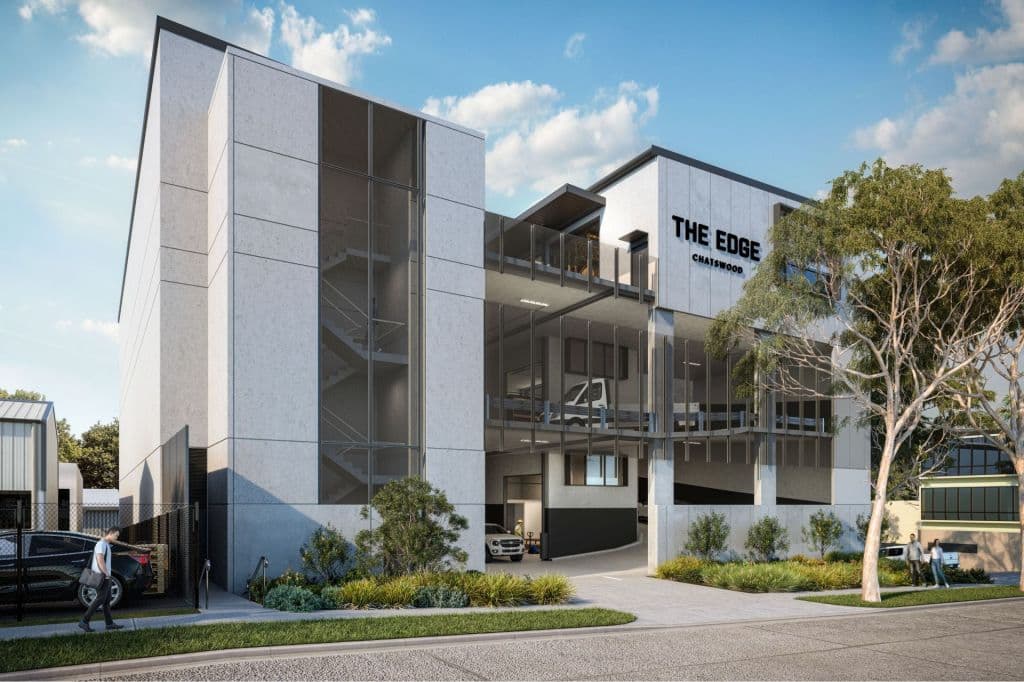
Li has seen this firsthand, with four major Chinese industrial buyers in two weeks for just one project. A newly built $30-million Sydney development called The Edge Chatswood, with 22 industrial warehouse units and nine storage units, sold four units off the plan to Chinese buyers at prices from $400,000 to $2 million.
“All four were locally based Chinese buyers who decided that industrial property today makes more sense than residential,” Li says. “One of the buyers is an investor who had about $1 million from past house and land and unit investments. When he found out the warehouses were so cheap compared to an apartment or house, he decided to invest.
“The other three recent Chinese buyers are all occupiers. One is purchasing office space and will share it with a friend who needs storage space for his business.
“Another is a kitchenware supplier for restaurants who will use the unit as a display, storage space and office. The last buyer is a downsizer who bought a basement storage space for things that won’t fit into his new home.”
Until recently, most Chinese investment in Australian commercial property was by large institutional-quality investors, with commercial assets accounting for 20 per cent of total Chinese investment in the country, according to KPMG.
However, now it’s Chinese mum-and-dad investors who are buying industrial property.
“Being able to buy real estate in Sydney for $1 million in suburbs where median house prices are $4 million appeals to a big audience,” says Julian Doyle, the founder of PlatformCo, which developed The Edge. “Investors want to get into the market, and we designed and sized these spaces to have an appealing price point.
“There is a very large Chinese community in Chatswood, and while I don’t know how much of the project will sell to Chinese buyers, I think it will be similar to the percentage of Chinese residential buyers in Chatswood.
“It’s an easier point of entry pricewise than residential and, in my opinion, more certain than commercial or retail.”
The industrial market has boomed nationwide post-pandemic. As people have decentralised their workspaces, industrial facilities have become workplaces for a whole new type of tenant, from trade and logistics with increased last-mile distribution to those seeking workplaces close to home, man caves and storage.
For Chinese buyers, these assets are particularly attractive as there’s no FIRB threshold for non-sensitive commercial properties up to $1.464 billion. For residential property, however, Chinese buyers are required to obtain FIRB approval for any purchase, with the application fee set at $45,300 for a $1 million established dwelling.
Zomart He believes that this move to industrial investment represents a structural shift toward more sophisticated, long-term portfolio management for generating long-term wealth among Asian buyers, rather than a speculative play.
Yet it’s still sometimes also about lifestyle. One of the Chinese industrial property buyers Li is working with is a late-50s Chinese buyer who just wants space for a ping-pong room.
“Warehouse units have high ceilings, so he plans to put his ping pong table there to play with his mates,” Li says. “He will convert the mezzanine to a tea house where they can drink tea and hang out.”