Wollert El Jannah and GYG freeholds listed for $6m-plus
Fast food has become a favourite flavour for investors, with buyers lining up to secure two newly developed properties in Victoria’s northern growth corridor.
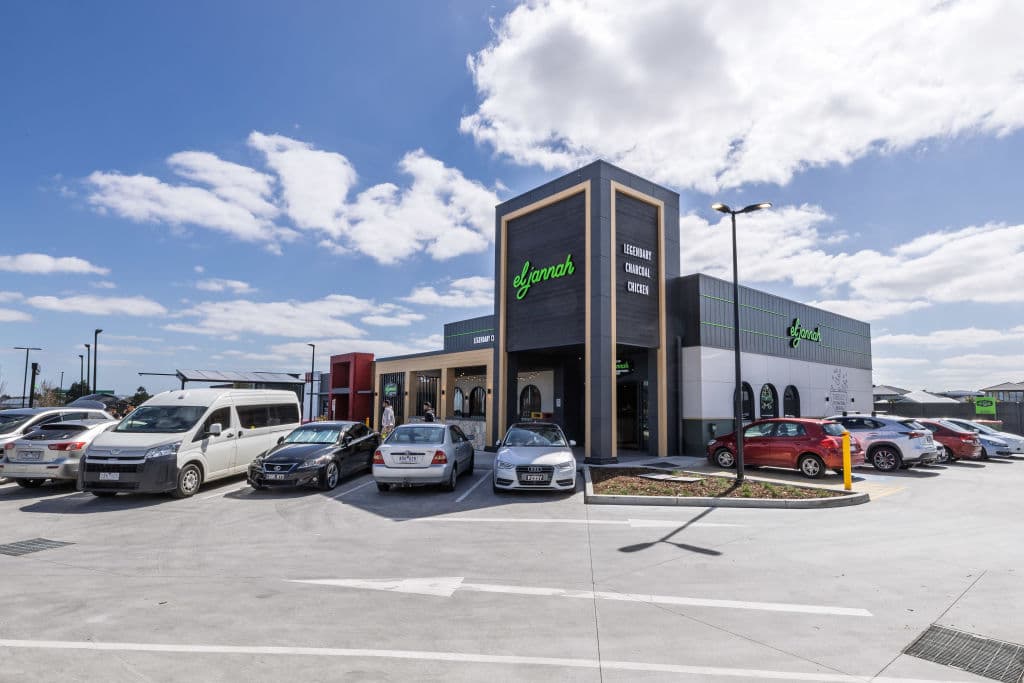
One is a 1572 square metre site that’s home to El Jannah, a cult favourite from Sydney, and the other is a 2230 square metre site with a Guzman y Gomez – and each is expected to sell for more than $6 million.
Buyers hungry for fast food investments
Both Wollert eateries opened just four weeks ago in a newly developed parcel of land that also contains a McDonald’s, KFC and BP.
Each freehold site comes with a 20-year lease, fixed 3 per cent increases for the 20-year period and no market review during that time.
CBRE’s Matthew Wright says investor interest in both the El Jannah and Guzman y Gomez properties was high.

“We’re getting a lot of interstate inquiries from Sydney, and they’re looking at Victoria now, thinking that maybe it’s a really good opportunity to buy in Melbourne,” Wright says.
“Clearly, yields are probably softer than they are in Sydney, given underlying land value and where Sydney is.
“We’ve had a number of buyers call up from Sydney on El Jannah because it’s the same lease covenant, great lease term, same income, and you’re arguably buying at the lowest point of the cycle.
“So interest has actually been really, really good for this.”
Commercial property attracts mum and dad investors
The interest comes as traditional residential property investors increasingly turn to commercial assets in the wake of federal government tax changes this year.
Fast food, in particular, has proved popular with mum-and-dad investors seeking low-maintenance assets with long lease terms.
CBRE research found that more than $94 million was spent on 18 freehold sales in the first half of this year.

“We’re seeing a whole lot more, let’s call it, ex-residential investors who have been probably a little bit wary of the government changes and now they’re going, ‘OK, well how do I get into commercial?’ and ‘OK, this isn’t actually that hard to get into from a capital point of view or an understanding point of view,’” Wright says.
“Mum-and-dad investors and commercial investors, they like the fact that you can visit your property and say, ‘That’s my El Jannah’ or ‘That’s my GYG where I can order a burrito’.
“I think it’s just that brand awareness and brand familiarity over the years.”
Unique business model appeals to investors
El Jannah has been a hit with Sydneysiders, who have quickly developed a healthy appetite for its Lebanese-style charcoal chicken.
It first opened in 1998 in western Sydney and has since expanded to 35 stores in NSW, 31 in Victoria and has just announced its first South Australian store will be in Glenelg.
Wright said the company’s unique vertical integration and supply chain model, where it manufactures its own products, including its garlic sauces, dips, and salads, was attractive to investors.
“Effectively, they grow everything – it’s sort of farm to plate; they even own the delivery vans, so there’s minimal leakage from a profitability point of view,” Wright says.
“There are no external delivery companies or any of that added cost to the business.
“So, what we generally look at from a fast food percentage is occupancy costs – so sales to rent – and that really gives us the viability of the business.
“In this instance, we’re really comfortable with El Jannah as a lease covenant because we know that their profitability is probably better than some other operators, given their structure.”
CBRE data shows 11 quick-sale restaurants sold nationally in the September quarter. They totalled $58,981,000 with the average yield at 5.28 per cent.