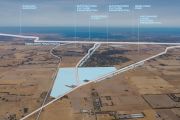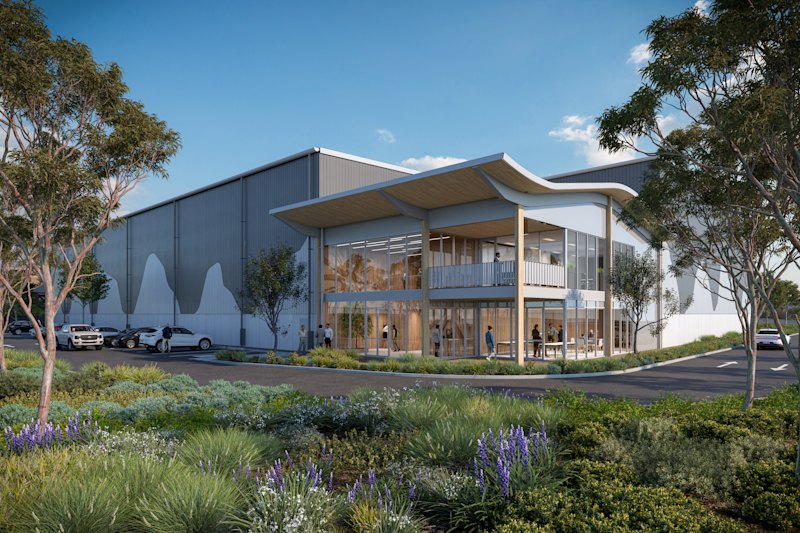

Mirvac has secured approval for the first stage of a $1.9 billion warehouse precinct on the edge of Western Sydney International Airport and says the 38 hectare facility that will open progressively from later next year will shift Sydney’s logistics sector westward.
The SEED facility, the first approval for the new airport business park under the NSW fast-track regime, has concluded no lease agreements yet but Mirvac was confident enough of demand to kick off construction “within weeks”, development head Stuart Penklis said.
Logistics operators that had previously relied on proximity to Sydney Airport and Port Botany would be able to take advantage of a curfew-free airport that was also connected to the deep-water container port by new road links such as the M12 and M7 motorways, Penklis said.
“The opening up of this land and the benefit of not only the new airport – which will obviously operate 24/7 – but also the infrastructure that will connect you back seamlessly to Port Botany and dramatically shortened travel times, means that opens up this whole new frontier for investment,” he told The Australian Financial Review.
“Existing users in some of those more traditional industrial suburbs are looking at Western Sydney now.”
It’s also likely to reshape the city. Logistics is one of a number of sectors slated to find a home in the 11,200-hectare Aerotropolis, a giant swathe of land including the airport itself, multiple train stations and the emerging Bradfield CBD and industrial businesses relocating west could in time free up land for housing development in a land-scarce Sydney.
Freight flights at Western Sydney International Airport are due to begin in July, with passenger flights from the end of October, chief executive Simon Hickey told a Senate estimates committee this month.
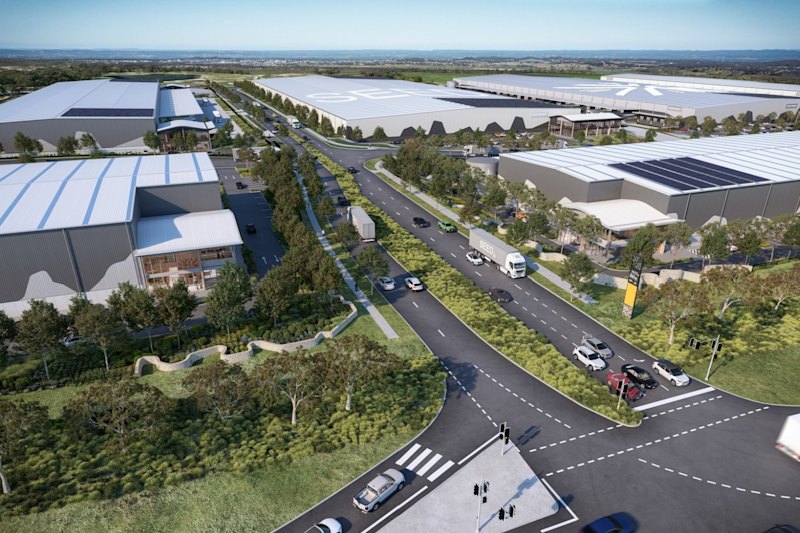
SEED, which is joinlty owned by ASX-listed Mirvac and $350 billion super fund Australian Retirement Trust, will comprise 17 buildings, ranging from 2500 square metres to 100,000 square metres in size, across 90 hectares when fully developed.
The first stage will occupy 39 hectares and develop 140,000 square metres across seven buildings.
“We haven’t announced any of the pre-commits, but in saying that, we have conviction around commencing the project and completing the first phase of buildings,” Penklis said.
“By the end of next year, some of those buildings will be buildings that are built and leased on the basis of tenants committing to those spaces while the buildings are under construction.”
The second phase will deliver 240,500 square metres of space in the facility across a further 10 buildings, which Mirvac said targeted customers from logistics and advanced manufacturing to technology, aviation‑linked enterprises and emerging industries.
Announcing half-year earnings last week, Mirvac said industrial property demand was normalising after exceptionally strong growth in recent years but that low vacancy rates and the demands of a growing ecommerce sector would keep driving demand.
Net operating income of the company’s industrial assets rose almost 14 per cent to $41 million in the six months to December from a year earlier, the second-biggest gain in Mirvac’s investments portfolio after a 15 per cent increase in its living sector income.
Industrial assets benefited from a 3.3 per cent upward revaluation over the period, more than the 2.5 per cent gain in retail assets and 3.1 per cent boost to living-sector asset values.
SEED is the third industrial project in which Mirvac and ART have partnered after the Aspect Industrial Estate at Kemps Creek and the Switchyard industrial estate in Auburn, both of which are in Sydney.
“ART is proud to continue our partnership with Mirvac on SEED,” said Michael Weaver, the fund’s general manager for mid-risk assets.
“This project will contribute to western Sydney’s economic development and create jobs while targeting strong, long‑term outcomes for our members’ retirement savings.”
Separately, the annual value of non-residential construction grew for the first time in two years in the December quarter, Australian Bureau of Statistics figures showed on Wednesday.
Non-residential building picked up to $65.8 billion over the four quarters, a 1.8 per cent increase on the same period a year earlier.
Total residential building, meanwhile, jumped 7.3 per cent year on year in value to $105 billion and while the value of engineering construction was up 2.1 per cent year on year at $147 billion, the pace of growth slowed.
A year earlier the total was up 5 per cent year on year and at end-2023, it was up almost 17 per cent on the previous four quarters.