Melbourne Airport Rail’s 2028 construction start sparks north-west commercial property shift
Commercial and industrial properties along Melbourne’s north-west corridor are back in focus after the state and federal governments on Wednesday committed to begin major construction on the next stage of Melbourne Airport Rail in 2028.
The 7.4-kilometre section will run from Albion to a new Keilor East station and include a 500-metre rail bridge across the Maribyrnong River. Keilor East station is due to open by 2031, although a timetable for the final connection to Melbourne Airport is yet to be finalised.
Site investigations, procurement and development works are expected to begin within weeks, bringing greater certainty to a corridor where some properties have been earmarked for a future airport rail link for more than two decades.
Victorian Premier Ben Carroll said the government was “getting on and delivering” a direct rail link to the airport.
For commercial property owners, however, the project presents a more complicated picture, with some sites facing acquisition or construction disruption and others benefitting from new infrastructure, development opportunities and improved transport access.
Acquisition risk moves closer
A Public Acquisition Overlay has covered land required for the future Melbourne Airport Rail route since 2005, including sections outside the existing rail reservation.
Property consultancy Urbis says the project has required whole and partial compulsory acquisitions, as well as temporary occupation of land in Sunshine, Albion, Sunshine North, Keilor East and Tullamarine.
A 2021 business impact assessment prepared for Rail Projects Victoria indicated the potential scale of disruption under the project design considered at the time.
It estimated 16 businesses in the areas required for permanent works would need to relocate, while about eight could be affected by temporary works. Some were projected to face revenue losses of more than 30 per cent or, in some cases, be unable to operate during construction.
Fifteen of the 16 businesses identified for permanent impact were already sitting within the Public Acquisition Overlay.
Those figures relate to the 2021 design and should not be treated as a current acquisition list for the newly announced Albion-to-Keilor East stage, with detailed design and consultation still to come.
The other side of the tracks
For other property owners, the rail investment could bring opportunities rather than disruption.
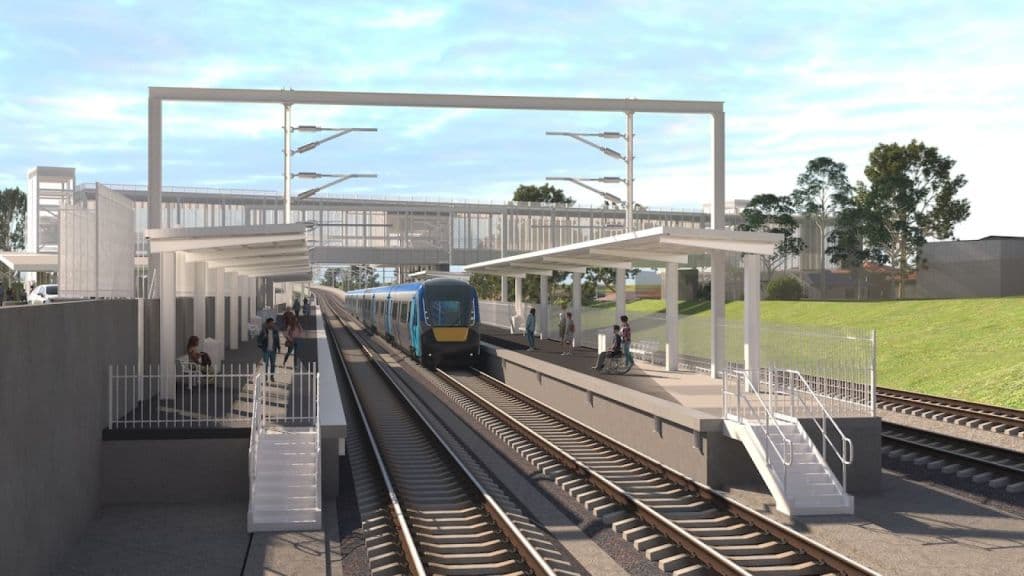
More than $4 billion is already being invested in stage one of the line between West Footscray and Albion, including redeveloping Sunshine Station into a major transport hub and adding new stations at Tottenham and Albion.
The Sunshine works are designed to support future development around the station precinct, and earlier project assessments have found improved transport connections could make Sunshine and Albion more attractive for redevelopment and investment.
Further north, the property market surrounding Melbourne Airport is already constrained by a shortage of industrial land.
In February, while marketing the final developable landholding at Haystone Business Park in Tullamarine, CBRE said demand for industrial land near the airport was intensifying as supply across Melbourne’s north tightened.
Melbourne Airport itself has previously acknowledged the shortage.
“The fact is we are running out of land,” Stuart Verrier, head of property development and asset management at airport operator Australia Pacific Airports Melbourne, said of its 565-hectare business park.
Decades of uncertainty
The property implications have taken an unusually long time in the making.
Plans for a rail connection to Tullamarine stretch back more than 60 years, while the current corridor has been protected through planning controls since 2005.
The latest version of the project gained momentum in 2018 when the federal government committed $5 billion, later matched by Victoria.
It was delayed again in 2023 amid a federal infrastructure review and a dispute between Melbourne Airport and the Victorian government over whether the airport station should be underground or above ground. Melbourne Airport dropped its preference for an underground station in 2024.
Construction is now underway on the West Footscray-to-Albion stage, and is scheduled to finish in 2030. The newly announced stage will push the railway another 7.4 kilometres north to Keilor East the following year.
For owners and occupiers along the corridor, that means a project that has spent decades appearing on planning maps is increasingly becoming a reality.
As designs progress, it will become clearer exactly which properties will be acquired or disrupted by the next stage, and where new development opportunities may emerge around the multibillion-dollar infrastructure investment.