How intergenerational care campuses are reshaping aged care and childcare design
Aged care and childcare have long operated as silos, but an emerging care model is bringing the two together.
Intergenerational care connects different generations – often children and older people – through shared spaces and programming. Its benefits are wide-ranging, for the residents and families who use its services and the organisations that operate them.
In Australia, intergenerational care is delivered in a range of formats. There are playgroups and programs across Australia, along with a handful of facilities where aged care and childcare are housed on the same site.
The concept of an intergenerational campus might seem simple: place two care settings next to one another and see what happens. But Emeritus Professor Anneke Fitzgerald, chair of the Australian Institute for Intergenerational Practice (AIIP), says it isn’t just about co-location, but intentional interaction between two generations.
“It’s not simply entertaining older people with young children,” she says. “Intergenerational practice is the intentional coming together of older and younger generations for a very specific purpose. There has to be a reciprocity and a mutuality to it.”
She says the relationships created are one of the approach’s biggest benefits, especially in a society where older generations are often isolated from younger people. Research shows that intergenerational models can improve wellbeing, foster empathy and respect in young children, and potentially benefit physical and cognitive health.
“It also creates a sense of purpose and belonging,” Fitzgerald says. “Rather than feeling you are a burden as an older person, you actually have … something that gets you out of bed in the morning.”
Why intergenerational care is more than co-location
According to AIIP’s secretary Lysha Lee, design is integral to an intergenerational care facility’s success. Instead of forcing people together, the built environment needs to create organic opportunities for them to connect.
“You can have two buildings next to each other, but if they don’t feel like they have shared spaces where they both belong, it will just remain as two different spaces,” she says.
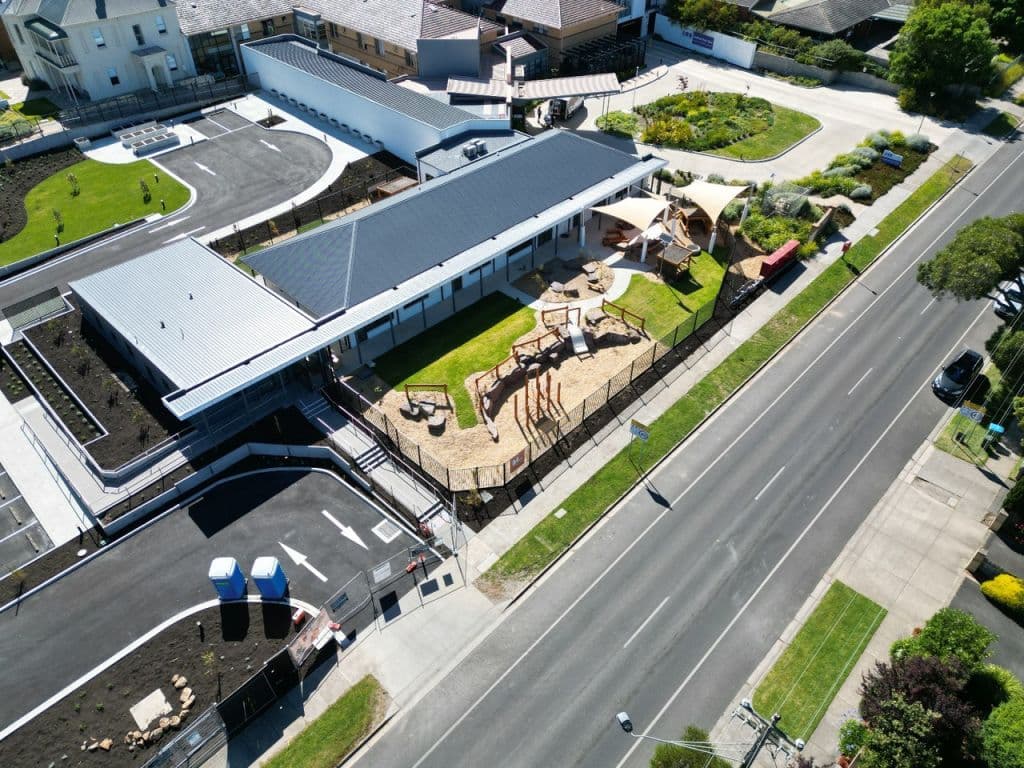
An example of that approach in action is The Herd, an intergenerational campus located just outside metro Melbourne and led by Anna and Fiona Glumac. It has an aged care centre run by Uniting AgeWell, while The Herd childcare occupies the adjoining building.
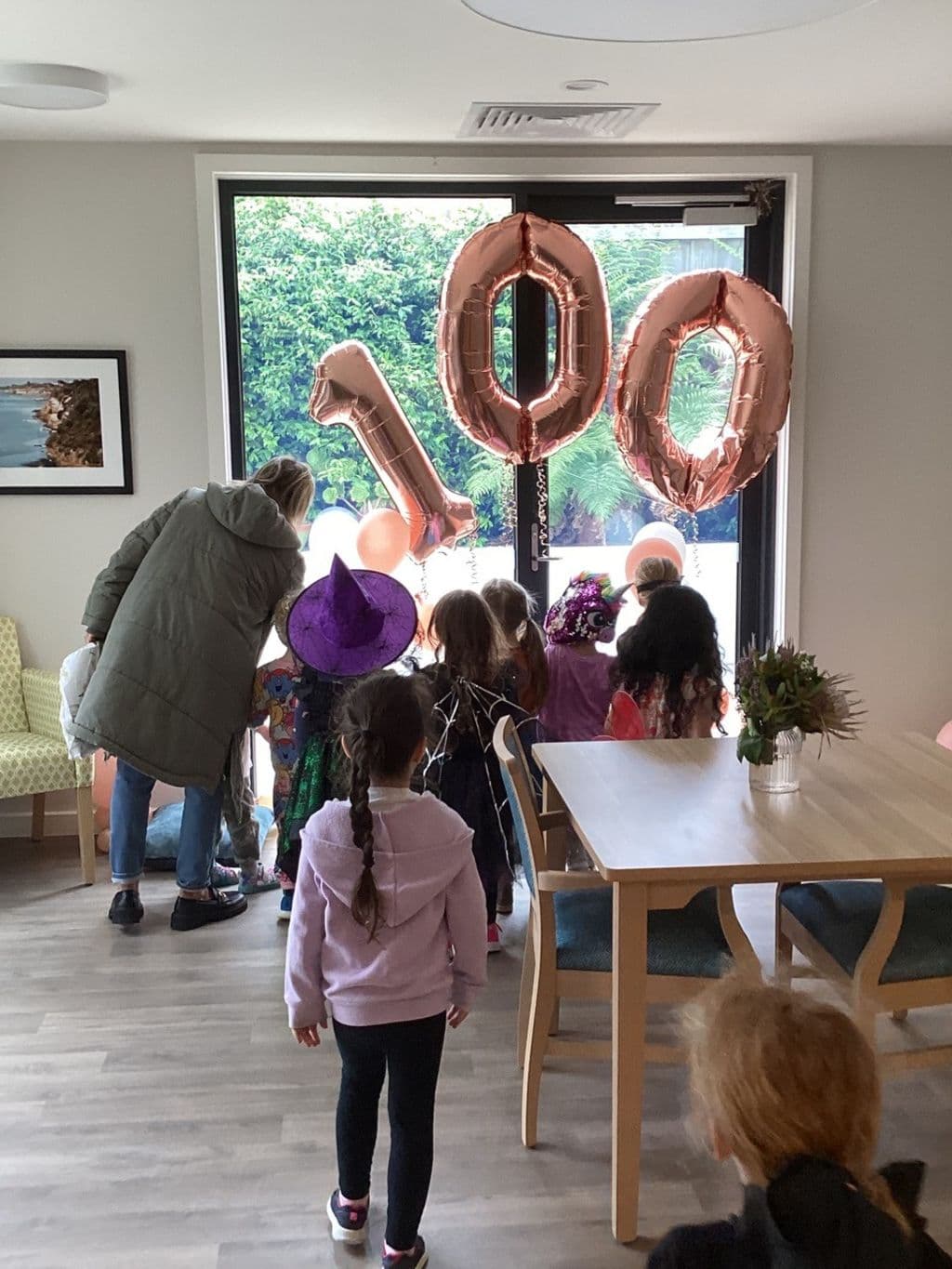
Anna Glumac points to a number of features that encourage interaction between the two, including a communal lounge, large windows that overlook childcare spaces, a sensory garden and other shared spaces.
The viewing windows are particularly useful during illness outbreaks, allowing residents and children to maintain contact when they can’t share a physical space.
“We have discos, play charades, paint beautiful patterns on the window together and do treasure hunts through the glass,” Glumac says. “The children and residents have found all sorts of creative ways to connect.”
The Herd shows how the model works in practice
Beyond the building, Fitzgerald says ongoing programming is key.
“It’s not about the activity; it’s really about the relationship being created and the connectivity that is being created,” she says. “It takes time. It’s not just a program that does that,” she says.
At The Herd, interaction happens through shared activities like art and music, communal meals and regular events.
Adaptive reuse offers a lower-cost pathway to delivery
In 2022, TLC Healthcare opened a purpose-built intergenerational care facility in Melbourne’s Mordialloc, which it described as the first multigenerational healthcare precinct in Australia.
But existing buildings also have the potential to accommodate the model.
The Herd, for instance, presented a somewhat unusual adaptive-reuse proposition. It combined a newly built Uniting AgeWell aged care centre with an existing building that was retained for the childcare component.
Arda Sander, director and architect at Wurl and the designer behind The Herd, says the project demonstrated a cheaper way to implement the model without building a new facility from scratch.
“If they’ve got something to demolish, they shouldn’t be saying, ‘Alright, this is an old building, let’s get rid of it. Let’s build a new one,’” he says. “Instead, maybe this could be an opportunity, a cheaper way to integrate a childcare centre into the building.”
That said, he highlights the challenges of working with an established space. Because the building wasn’t purpose-built for the childcare centre, the team had to work around its existing layout. There was no conventional corridor or dedicated lobby, so people often had to pass through some rooms to reach others.
While this was initially seen as a limitation, Sander says it ultimately worked out in the project’s favour.
“That creates the opportunity to interact,” he says. “But if you’ve got a dedicated corridor, you don’t have that opportunity. You’ve got a corridor and doors, and you go where people tell you to go. And there is no opportunity to interact.”
The business case for aged care and childcare integration
Intergenerational care centres may also present compelling benefits to landlords and operators.
For one, co-location offers potential operational efficiencies.
“There are also opportunities for organisations to share resources, collaborate and create efficiencies that wouldn’t necessarily exist in standalone services,” Glumac says.
Fitzgerald says they can offer a point of difference, referring to research that found parents were willing to pay for intergenerational experiences. She also points to the extensive waiting list at The Herd, which is currently up to two years.
“The competitive advantage is really something that we researched,” Fitzgerald says. “We were really surprised that parents were more than willing to pay for this extracurricular exercise, much in the same way they would pay for Japanese or dance classes or anything like that.”
Glumac says the model is also a drawcard for staff, helping with attraction and retention.
“For people working in aged care, having on-site childcare is a genuine practical benefit,” she says. “It can make a significant difference for families trying to balance work and caring responsibilities.
“Our early childhood educators are very much drawn to the stronger sense of purpose that comes from being part of something bigger than traditional early learning.”
What’s holding back wider adoption in Australia?
Despite the benefits, Fitzgerald says Australia has been relatively slow to adopt the model, with workforce shortages, limited training and the need for greater research and evidence among the barriers.
But she does see it becoming more mainstream and possibly expanding beyond childcare and aged care to include school-aged children.
In some ways, that could mark a return to a more connected model of community rather than one separated by age.
“It’s really back to the future,” Fitzgerald says. “To be honest, 100 years ago, nobody would have come up with this because it was just normal.”