Hobart’s largest industrial development site to hit the market
Hobart’s largest industrial development landholding, owned by a prominent local developer, will hit the market later this year with price expectations of $60 million.
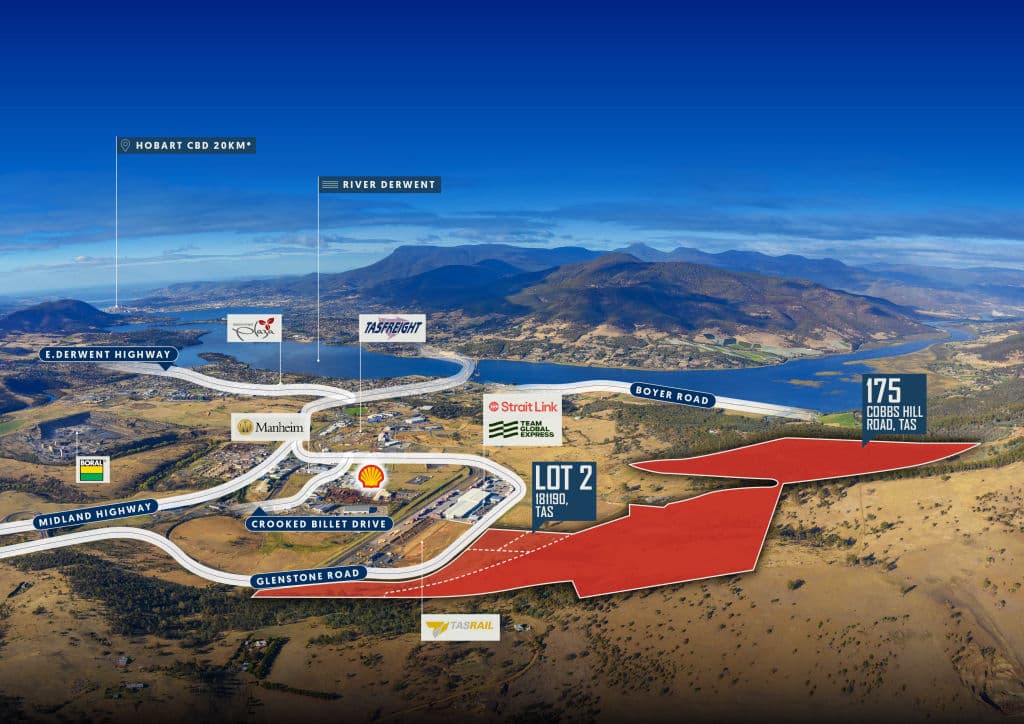
The Bridgewater Industrial and Logistics Land Portfolio consists of a 76-hectare industrial landholding that forms part of a broader 192 hectares. It will go on sale subject to an active rezoning application to increase the percentage of land zoned General Industrial.
The properties owned by Andrew Bullock – Lot 2 Glenstone Road and 175 Cobbs Hill Road, Bridgewater – sit next to TasRail’s Brighton intermodal, a 50-hectare facility for the transfer of freight between rail, road networks and state-wide ports, and hosts major logistics operator Toll Group.
Cushman & Wakefield’s Cameron Zamora and David Norman are managing the sale of the landholding, which is 25 minutes from Hobart’s CBD, the airport and the Cambridge Industrial Estate.
“Industrial land supply across Greater Hobart remains tightly held, with limited large-scale rezoning opportunities and low vacancy across established precincts, including Glenorchy and Cambridge,” Zamora says.
“The sale of the Bridgewater offering, combined with its proximity to key infrastructure, positions it as a strategic platform for future industrial expansion.”
Zamora describes Hobart’s industrial property sector as “a sleeping giant”, noting the region’s infrastructure has been delivered, and supply is structurally constrained, but prices haven’t shifted to reflect those factors.
“Demand fundamentals are being further underpinned by major economic investment across the region,” he says.
“Number one is the $786 million Bridgewater Bridge project that opened last year, which has significantly improved freight efficiencies through the corridor, and then you have the [proposed] Macquarie Point [AFL] stadium, which will be a catalyst for broader economic activity.”
Bullock is no stranger to large developments in Hobart. With the support of his son, he runs three companies across civil construction, recycling and property development in addition to a 182-hectare farm that supports renewable energy initiatives.
“I started Bullock Recycling Services in 2013 after seeing the enormous amount of construction material being set to landfill through our civil construction operations,” he tells Commercial Real Estate.
“I believed there had to be a better way, [so] we began processing and recovering those materials, turning waste into reusable, construction-grade products that often performed as well, or even better than, natural quarried materials.
“The business quickly grew due to strong demand, which led us to acquire additional land [200 hectares] and establish the Brighton Regional Resource Recovery Precinct within Tasmania’s transport hub.
“The precinct has allowed us to expand recycling operations while also creating a platform for future-focused infrastructure, including green hydrogen production, renewable energy generation and sustainable logistics.”
Bullock says his long-term business goal is to decarbonise the transport and manufacturing sector and contribute to a more sustainable energy future for Tasmania.
His vision for the Bridgewater site is just as ambitious. He wants to see the land portfolio transformed into one of Australia’s leading industrial precincts focused on transport, logistics, manufacturing and clean energy solutions.
“The vision is to create a large-scale industrial hub that integrates renewable energy, recycled resources, decarbonised gas and green hydrogen to help reduce reliance on fossil fuels,” Bullock says.
“I believe Tasmania has an opportunity to lead in this space. While some people say these ideas are 20 years ahead of their time, I believe there’s never a wrong time to invest in a better future.
“Ultimately, I want to help create an industrial precinct that supports job, manufacturing and logistics while also contributing to a more sustainable future for the next generation.”
Since buying the Bridgewater properties close to five years ago, Bullock has been working with the council on rezoning the portion that is not already zoned General Industrial and actively improving the sites, which includes building an initial road network.
Zamora says excavations have revealed basalt and dolerite formations across portions of the land – dolerite is used for road base – which will reduce haulage and lower reliance on imported fill.
As for the sale, the agent says they are open to a “flexible offering”, which could be a staged acquisition or an opportunity for the buyer to purchase a portion of the land in a joint deal. He adds that Bullock is “happy to stay on the project, to a degree.”
“If someone was wanting to do a joint venture, he would be open to that sort of structure as well,” Zamora says. “With his experience, he’s an asset to this sale.”