David Jones collapse puts shopping centre landlords at a crossroads
Landlords facing the loss of David Jones stores could re-let some of the largest and cheapest spaces in their centres at higher rents, property experts say, but only after costly refits that could take more than a year.
The 188-year-old department store was placed in voluntary administration on Thursday, with McGrathNicol appointed administrator. Secured lender Hilco Capital appointed FTI Consulting as receivers and managers.
All 38 stores remain open while the receivers review the business, but FTI’s David McGrath told staff it was “likely there will be steps to reduce the retail footprint in the near-term”, the ABC reported. McGrathNicol is running a sale and recapitalisation process, and the first meeting of creditors is due next week.
Owner Anchorage Capital Partners has described a smaller “David Jones 2.0” as “a live option” but has not made a firm offer, according to The Australian Financial Review.
Scentre, Vicinity among landlords exposed to David Jones
Scentre Group, owner of the Westfield centres, is the largest landlord, with 17 stores covering about 200,000 square metres. David Jones accounts for about 1.8 per cent of its gross rent. Scentre holds about $30 million in bank guarantees, and says the retailer had not paid rent since September 30.
Vicinity Centres has four David Jones stores, worth about $34 million a year, or 2.4 per cent of its gross rental income, Vicinity told the ASX. The company says it is owed $2.2 million, holds no bank guarantees on the leases and is reviewing its earnings guidance for the year to June 2027.
GPT Group and Stockland are each landlord to three stores. QIC, which owns the Robina Town Centre on the Gold Coast, has already assessed alternative leasing and redevelopment options for its David Jones space, according to the ABC.
Owners of standalone buildings carry more concentrated exposure. Charter Hall Long WALE REIT owns half of the Elizabeth Street flagship in Sydney, which, it told investors on Thursday, makes up about four per cent of its net property income. The lease runs to 2040, and the REIT holds a bank guarantee covering about 12 months’ rent.
The Bourke Street flagship in Melbourne is owned by IP Generation, which bought the building from David Jones in January 2025 for $223.5 million. IP Generation has since become part of MA Financial.
Singapore-listed Starhill Global REIT owns the David Jones building in Perth, where the retailer occupies 95.1 per cent of the lettable area. Starhill said its distribution per unit would fall about 10.6 per cent if the space sat empty for 12 months, The Business Times reported.
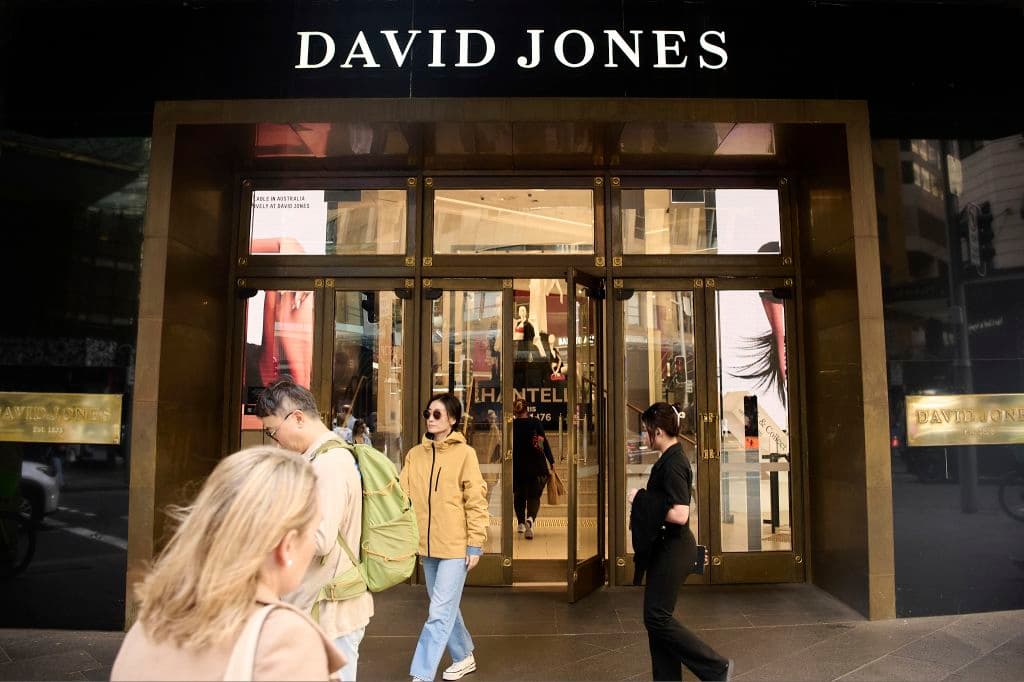
How David Jones’ long-term leases became a burden
A source close to the business dealings told Commercial Real Estate the store network had become too expensive to carry once sales growth stalled.
“David Jones now has 38 stores, down from substantially more at one point, but legacy leases tie it to significant annual commitments,” the source said. “Unless top-line sales and underlying profitability grew, the business cannot offset the natural increases in occupancy costs.”
David Jones declined to comment.
The retailer’s push into luxury brands over the past five years required heavy spending on its stores. “Its long-term strategy to differentiate itself was sound, but the underlying economics did not work,” the source said.
Shrinking the network was seen as critical by the time Woolworths Holdings sold the business to private equity in 2023.
“There was talk from at least COVID times of the need to close doors to ensure the business’s viability over the long term,” the source said. “David Jones was unable to do that. It either lacked leverage with landlords or landlords were unwilling to provide support.”
Management had been in talks with landlords about reducing the network before the appointments.
The Australian Financial Review reported last week that David Jones wanted to cut between 12 and 20 stores and had asked for substantial rent relief, including no rent in December. Most of its stores have 10 to 15 years left on their leases.
David Jones store closures could deliver rental upside
Shaun O’Sullivan, national director, retail, at M3 Property, said taking back a department store was “not always a loss”.
“There are cases where a department store is paying $100 per square metre, and the space can be backfilled with larger retailers paying about $500 per square metre,” O’Sullivan said. “That represents a reasonable uplift in rent, although it must be weighed against the cost of repurposing the space.”
David Jones pays Scentre an average of $352 a square metre, according to the landlord. The average across Scentre’s portfolio is $942 a square metre.
O’Sullivan said the role of department stores in centres had shrunk.
“The prominence of department stores has diminished over the years compared with what it used to be,” O’Sullivan said. “But it is a centre-by-centre, case-by-case situation, depending on the particular attributes of the department store, how it resonates with the catchment and where it is located within the centre.”
Hannah King, a commercial real estate director with experience in retail leasing advisory, said anchor tenants were still central to leasing.
“Anchor tenants, such as David Jones, are disclosed in the initial stages of any lease negotiation and form part of the conversation at all shopping centres across the country,” she said.
King said landlords should see the loss of David Jones as a chance to lift traffic.
“If anything, this is an opportunity to get on the front foot and replace large tenancies with new and exciting retailers that will enhance the foot traffic where there has been a decline,” she said.
But getting there won’t be easy.
“It is likely to take 12 months or more by the time the landlord develops a scheme, secures retailers, works through the feasibility and completes the design process,” O’Sullivan said. “There is likely to be a reasonable period of downtime.”
He said upper floors that did not connect with a mall were “very difficult to repurpose”, and that some weaker centres had been left with space that was “harder to fill”.
What could replace David Jones stores?
O’Sullivan said likely replacements included Timezone, where the space connected to a leisure precinct, and large-format retailers including Rebel, Kathmandu and Uniqlo.
He pointed to Vicinity’s Emporium Melbourne, where Myer vacated an upper floor about three years ago. The space became one of the first Rebel superstores, with basketball and soccer facilities and some co-working space.
“That has been a real positive for the upper level of the centre,” O’Sullivan said.
Scentre has reported a 6.2 per cent increase in visits to Westfield Tuggerah in the eight weeks after new retailers opened, following the closure of its David Jones store in January.
King said centre management and existing retailers would already have discussed David Jones’ likely closure.
“The news should not come as a surprise to any landlord or executives,” she said.
Where Myer fits
Myer shares rose 10.9 per cent on Thursday.
“The market now only supports a single national major department store, and that is likely to be Myer Group,” the source told Commercial Real Estate.
“If David Jones were to fail, Myer would be the natural player to take some of its sites. Myer’s strategy should be to consolidate overlapping stores and target key locations it does not currently serve.
“I would expect that landlords will be engaging Myer to look at new sites where it makes sense.”
However, the source added that Myer would first need to spend on its own stores. “Myer has the margin, but it has not invested sufficiently in real estate,: they said. “Myer will therefore have to invest heavily.”
Investment in its physical stores is part of Myer executive chair Olivia Wirth’s transformation strategy. The company has just reopened its refurbished store at Galleria in Morely, Perth.
Its Sydney CBD flagship is next. Myer is rebuilding the ground floor as a 4500-square-metre beauty hall, triple the size of the existing space, which is due to open next week and is intended to set the tone for the rest of its fleet.