Australian self-storage investment surges 889 per cent to $6.86b
Australia’s housing supply crisis might be turning the screws on home-buyers, but it’s proving lucrative for a niche investment class.
Investment in self-storage facilities has skyrocketed, with billion-dollar deals sending volumes to record highs.
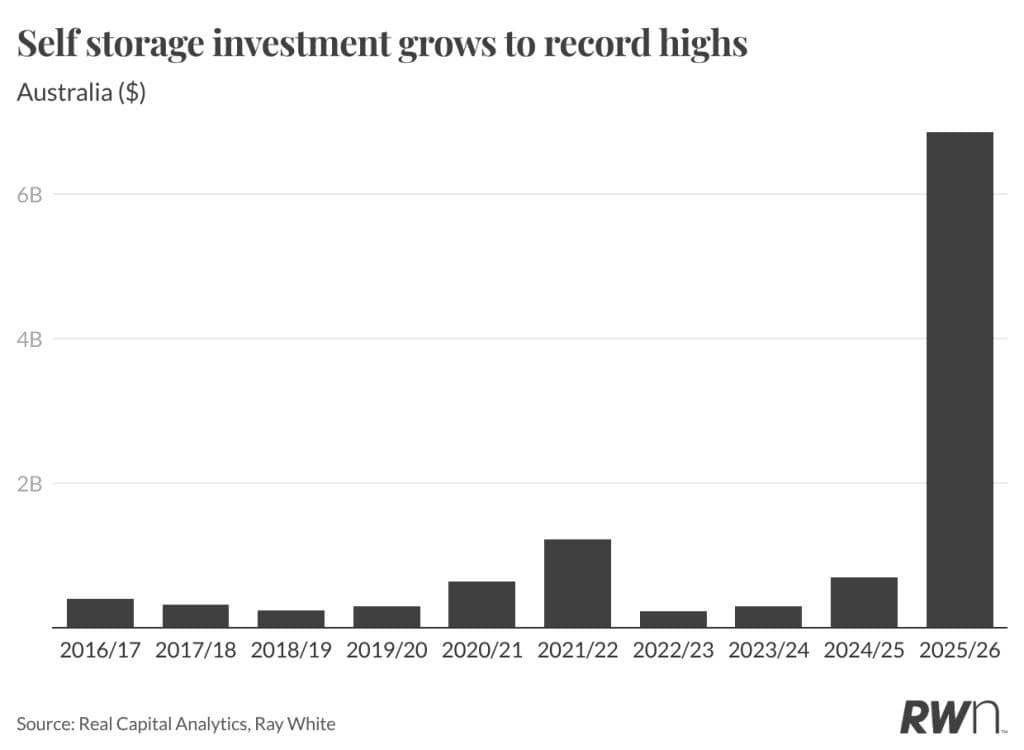
Total transactions reached $6.86 billion in the 2025-26 financial year – up a whopping 889 per cent on the previous year, according to Ray White Commercial data.
Key demand drivers
The market’s increasing appetite for self-storage comes down to strong demand from downsizers, renters living in high-density apartment buildings or shared homes, and businesses searching for low-cost alternatives to traditional warehouse leases, says Vanessa Rader, head of research at Ray White Commercial.
“Properties are getting smaller, there are fewer big garage spaces, and there are people moving into shared accommodation,” Rader says.
“People are just reluctant to chuck stuff. If you get grandma’s hand-me-down massive table that’s never going to fit in your house, but you don’t want to chuck it, you stick it in storage.”
Growing investor appetite is also being fuelled by the low-maintenance nature of self-storage facilities. Most operate with automated security systems and CCTV, and the only outstanding costs are power bills, insurance and council rates.
“They’re very easy to manage, and there are very few costs associated with it – and the tenant pays all those costs,” Rader says. “So it’s a very good bricks and mortar investment for the owner.”
Pricing and occupancy
Self-storage unit costs vary depending on size and location. StorHub data shows a small locker of between one to three square metres costs between $70 and $120 a month in Sydney, $65 and $100 per month in Melbourne, $55 and $90 a month in Brisbane, and $60 to $95 a month in Adelaide.
Costs for larger units between nine and 12 square metres start from $600 a month in Sydney, $500 a month in Melbourne, $400 a month in Brisbane and $420 a month in Adelaide.
National occupancy rates sat close to 90 per cent at self-storage centres for much of the 2025-26 financial year. It’s a level that remained stable even when new supply came onto the market.
Ray White Commercial figures found yields hovered around 5 per cent in the 12 months to June 30 this year. This aligns the sector with prime industrial benchmarks and makes it an attractive proposition for institutional capital searching for comparable returns without the scale constraints of traditional logistics assets, Rader says.
“At the end of the day, it’s industrial land, which we know has been the best performing,” she says.
“It’s within infill areas because if people put their stuff in storage, they still want it to be close to where they are. You don’t want to go stick it in some regional area, or you have to drive forever to get to it.”
Offshore capital surge
Offshore interest in Australia’s self-storage market is peaking. This year saw the finalisation of the huge privatisation deal between Canada’s Brookfield Asset Management and Singapore’s GIC, which acquired National Storage REIT. The acquisition of Australia’s largest owner and operator of self-storage facilities involved 273 properties nationally.
It’s a shift away from the period when US capital, through groups such as Blackstone and Public Storage, represented the bulk of international interest in the sector.
“With further portfolio consolidation likely and offshore capital continuing to seek scale in defensive, income-producing asset classes, self storage looks set to remain one of the more actively contested segments of the Australian commercial property market through the remainder of 2026,” Rader says.