How AI is splitting Australia’s office market into three tiers
The rapid proliferation of AI across Australia’s white-collar industries is splitting the office market into three different tiers: premium, mid and low-performance.
The trend is more distinct in some markets, especially those more exposed to AI disruption and augmentation, including Sydney and Melbourne.
Analysis by JLL has found AI’s influence on the office market is creating a new framework for valuing office assets and defining capital growth and risk.
The report – How is AI Reshaping Office Demand in Australia and New Zealand? – looks at three forces at work stemming from AI: the rates of reconfiguring existing roles, creating new jobs and replacing others.
“I think it’s fair to say that the underlying theme of our report is that employment growth in a world with AI becoming embedded will be slow,” says Ronak Bhimjiani, JLL’s national real estate economist.
“We can be fairly open about that because AI is either going to augment jobs or it might disrupt jobs, and in the short term, it actually might create new jobs.
“But as a whole, you could say you can expect slower growth, especially if you look at the economic landscape where economic growth is slower moving forward given what we’ve gone through.”
City-by-city AI exposure
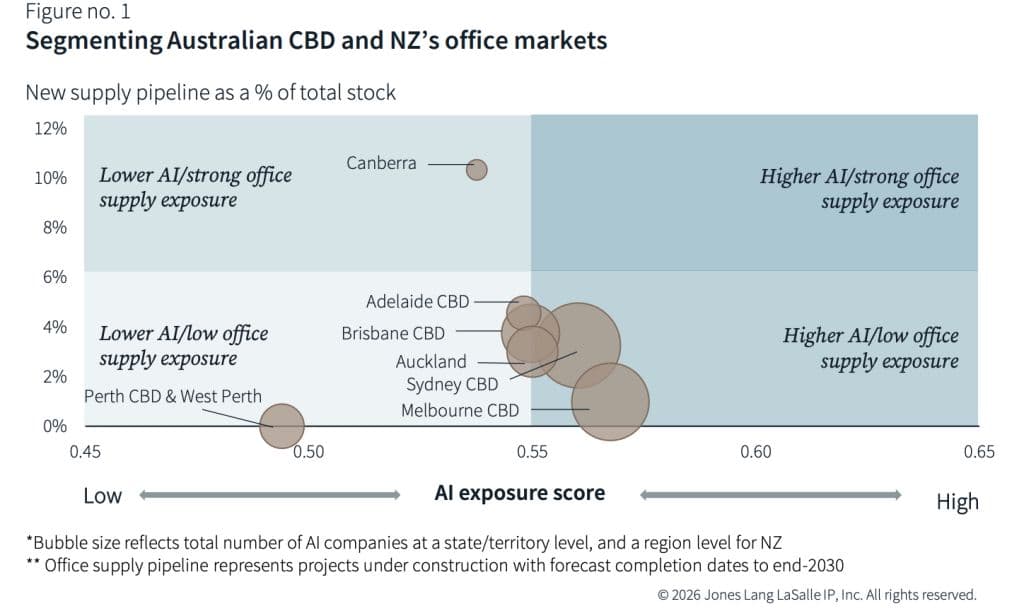
The impact of AI and automation varies across industries, and because of the clustering of some of those industries, it will make its mark differently in each city. The JLL report scored each Australian city on AI exposure based on workforce exposure to AI, the strength of local AI business activity and talent ecosystems, and the scale of new office supply in the pipeline.
Melbourne shows the highest AI exposure among Australian cities at 0.57, but it has the second lowest supply pipeline at 1 per cent of existing stock. It was followed closely by Sydney with a score of 0.56, and a supply pipeline of 3.3 per cent.
Adelaide and Brisbane both scored 0.55, then Canberra at 0.54 and Perth at 0.49.
“The stronger the AI exposure score, the more chances that AI could be a disruptor to employment growth or employment more broadly,” Bhimjiani says.
“Sydney and Melbourne have somewhat moderate AI exposure scores compared to markets like Perth and Canberra. But on the other side of the ledger, there’s actually been net positive demand happening in markets like Sydney CBD over the last six years.
“A lot of the AI companies have actually infiltrated markets like Sydney and taken up office space and therefore contributed to jobs. So a higher exposure score doesn’t necessarily mean that you’ve got to have job losses. You could actually see more demand simply because there’s more of an appetite for AI skills in those markets.”
The three new office tiers
JLL’s research team found cities with high AI exposure often have the strongest potential to capitalise on growth. This stems from a depth of talent, innovation capacity and sector diversity, which attract new investment and sustain office demand.
These combined forces have propelled the emergence of three distinct office categories.
The EQ market is made up mostly of premium and high A-grade offices where AI plays the part of enhancing roles and informing decisions. These offices have the best prospects for rental and capital value growth.
The HQ category is where low A-grade and high B-grade offices sit, and AI’s role revolves around productivity. There is stable growth across this group.
Then the VU group is made up of lower B-grade, C and D-grade offices deemed vulnerable to disruption by AI. These buildings have the highest risk of structural vacancy and obsolescence, and downward pressure on rents and values.
Understanding the dynamics of AI-driven change will help investors identify which markets are best positioned to absorb disruption and convert AI exposure into opportunity, says Selina Short, JLL chief executive Australia and New Zealand.
“To navigate potential disruption, it is critical to use scenario analysis, which considers not just the pace of AI adoption, but how technology interacts with workforce adaptability and real estate supply,” she says.