
Australia’s rich events calendar, contracting supply and international capital flowing into the hotel market will supercharge the sector in 2026, say property experts.
Hotel transaction activity bounced back in 2025 after a subdued 2024, with total deal value rising to about $2.2 billion, in line with the nation’s historical long-term average. A lack of new stock and growing demand would keep this rising, JLL’s Peter Harper said.
Increasing interest from international and domestic investors at a time when few new projects were coming into the pipeline was expected to continue, driving up the hotel industry’s transaction volume into next year and beyond, said Harper, JLL Hotels & Hospitality managing director.
“We’re very much at the end of the new development cycle. So we’re going to see very few new hotels built or open for the foreseeable future,” he told The Australian Financial Review.
“The underlying fundamentals of the Australian hotel market are so exceptionally strong that we’re going to continue to see such high levels of foreign investment into the market.”
As with housing and commercial property sectors such as office, the rollout of new hotel projects is hampered by high construction costs that make purchasing existing assets more feasible than developing new ones. That has been pushing prices higher.
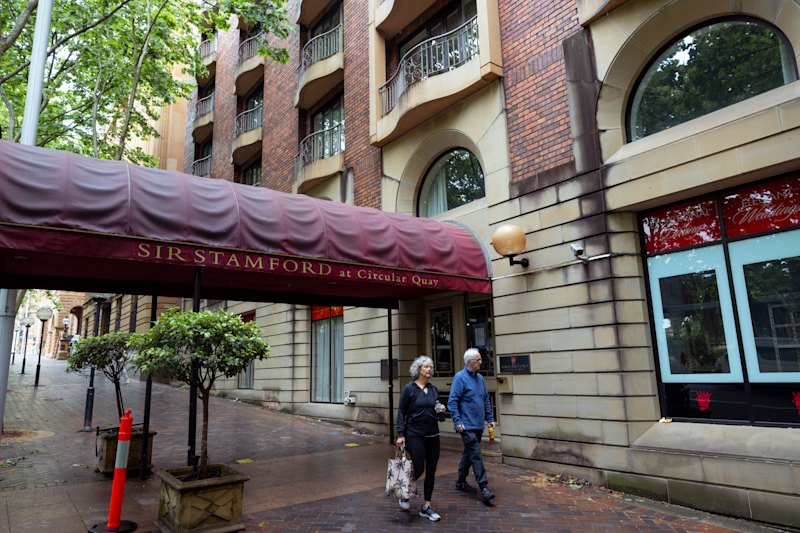
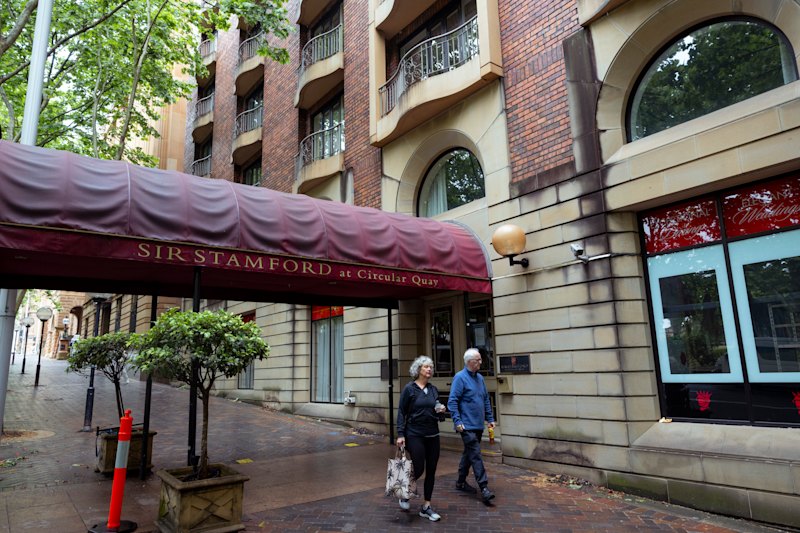
This biggest hotel deal this year was when Metrics Credit Partners acquired the Sir Stamford Hotel in Sydney’s Circular Quay from JDH Capital for about $265 million in February. It was once one of the city’s most luxurious hotels, originally the Ritz-Carlton before it was rebranded in 2000 to the Sir Stamford.
Thai hospitality group KS Hotels snapped up the Park Hyatt Melbourne for around $205 million in August, while global media and entertainment conglomerate The Generation Essentials Group purchased a 50 per cent stake in the Ritz-Carlton Perth for about $100 million.
The market is strong. Hotel room occupancy over 2025 averaged about 73 per cent, figures from agency CBRE show. Brisbane led the way in terms of revenue per available room (RevPAR) growth at 11 per cent, followed by Darwin and Perth at 9 per cent.
Tom Gibson, senior director at CBRE Hotels Asia Pacific, said all major markets in Australia experienced excellent growth through the year, supported by new flights and major events, especially in the second half of 2025.
“The first half of the year was quieter than we would have liked for transaction activity,” he told the Financial Review. “[But] we’ve got in excess of $1.3 billion worth of assets under contract or under offer, which we can announce in the new year.”
Collier’s head of hotels Karen Wales said several landmark deals currently in play could push volumes to record levels next year.
“Transaction volumes are projected to accelerate through 2026, underpinned by a growing weight of capital, constrained accommodation supply, and robust tourism fundamentals,” she said.
However, Dean Dransfield, a long-time transactions and development adviser to hoteliers, said talk about interest rates potentially rising in the new year was growing, which could slow the market in the first half of 2026.
“We probably hoped that the inflation bubble had been fully birthed, and there was too much other noise, particularly in terms of some of the economic stimulus, that meant that it didn’t drop off as consistently and as strongly as was first expected or hoped,” he told the Financial Review.
“But I think there’s a lot of capital still, certainly looking in the hotel space for quality assets.”
JLL’s Harper said capital from south-east Asia was increasingly turning to Australia’s hotel market.
“When the Australian dollar was where it was, Australian real estate just looked really cheap for investors trading or using certain foreign currencies,” he said. “We’ve seen KS Hotels make two established large transactions with the Park Hyatt and the Vibe.”
Singaporean investment company K3 Ventures sold the Vibe Hotel Gold Coast in Surfers Paradise for about $61 million to KS Hotels in March.
But activity was also being driven by local individuals and family offices refocusing on Australia after a period of distraction from presented opportunities across Asia – especially Japan – the UK and Europe, Harper said.
Australian property developer Rebel Property purchased the InterContinental Sydney Double Bay from Fridcorp for around $205.5 million to $207 million in February. Goldfields Property Development bought Quality Resort Sorrento Beach in Victoria’s Mornington Peninsula for about $31 million.
High building costs would hold back the development of new stock, CBRE’s Gibson said.
“We’re seeing construction costs forecast at a growth of 6 per cent to 2028 and that’ll be reflected in what we’re already seeing markets now with contracting supply,” he said. “There’s more quality coming in the market which will support rate growth.”
In the first quarter of 2026, Australia will have 4500 hotel rooms under construction that are due to open in the next two years. Most will be concentrated in Sydney, Perth and Melbourne, with 60 per cent classed as luxury or upper upscale, according to CBRE.
With about 10,500 new flights coming into Australia by the end of 2026 and a 25 per cent projected increase in short-term international visitors, Gibson said that demand was likely to outstrip supply, which would support hotel room price growth.